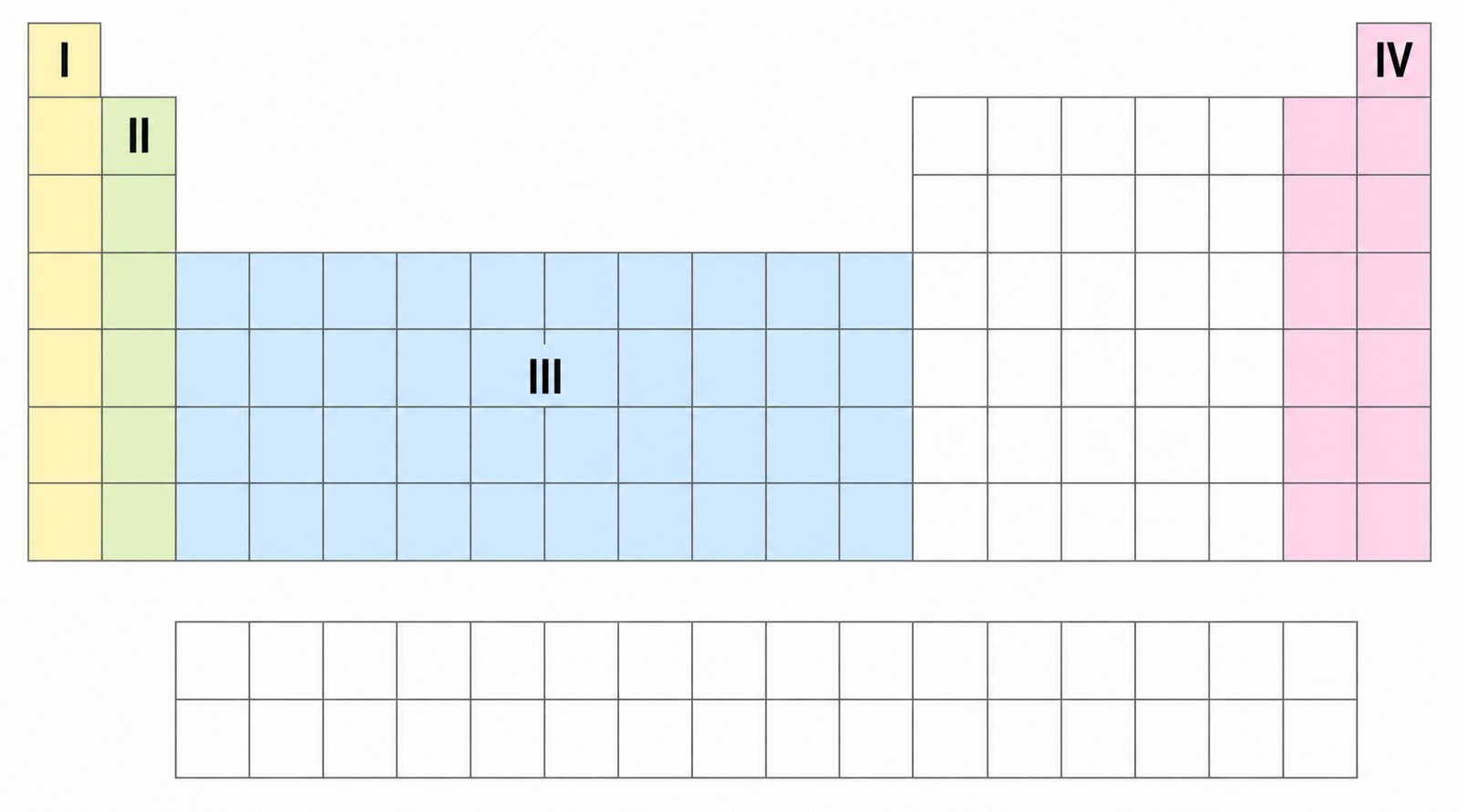
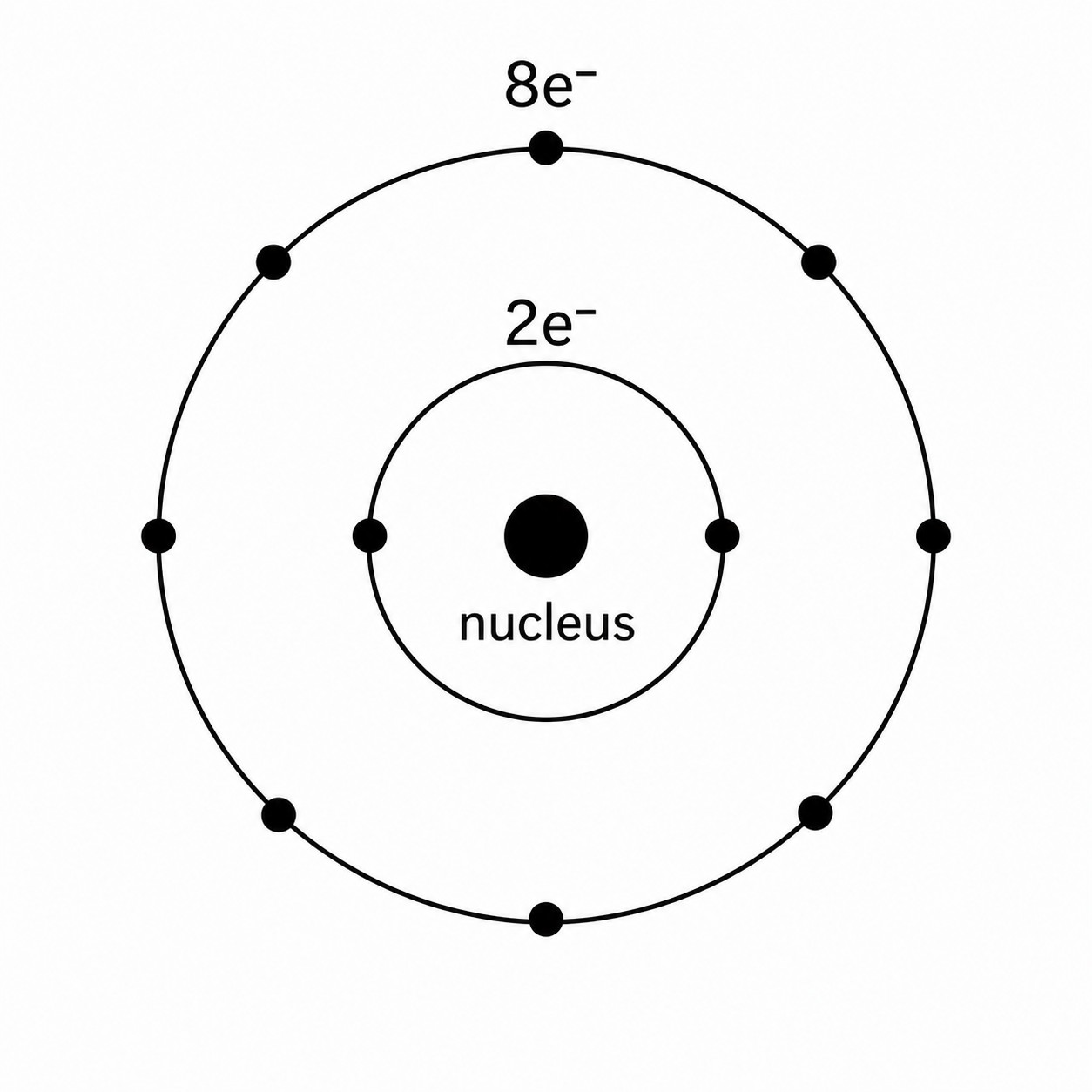
Magnesium reacts with oxygen to form magnesium oxide (MgO). Based on the electron transfer in this reaction, MgO is best classified as which type of compound?
AMetallic
BIonic
CCovalent
DPolar covalent
Explanation
📌 Magnesium (a metal, group 2) transfers its two valence electrons to oxygen (a nonmetal, group 16), producing Mg²⁺ and O²⁻ ions. The opposite charges attract → ionic bond. Rule of thumb: metal + nonmetal with large electronegativity difference → ionic. Two nonmetals → covalent.
Question 2 of 10
TEKS 5A-5CMedium
Which of the following neutral atoms has the SMALLEST atomic radius?
ANeon (Ne)
BFluorine (F)
CLithium (Li)
DCarbon (C)
Explanation
📌 Atomic radius decreases left-to-right across a period because nuclear charge increases while electrons fill the same shell — the stronger pull compresses the atom. Among Li (3 protons), C (6), and F (9), fluorine has the strongest nuclear pull and the smallest radius. (Note: Ne is often shown larger because covalent radius isn't well-defined for noble gases.)
Question 3 of 10
TEKS 1A-3FMedium Calc Word
A student measures the mass of a metal sample as 12.450 g and its volume as 4.50 mL. What is the density of the metal, reported to the correct number of significant figures?
A2 g/mL
B2.7666 g/mL
C2.8 g/mL
D2.77 g/mL
Explanation
📌 Density = mass ÷ volume = 12.450 g ÷ 4.50 mL = 2.766666… g/mL. Significant figures rule for division: the answer carries the same sig figs as the LEAST precise measurement. 4.50 mL has 3 sig figs (mass has 5), so the answer rounds to 3 sig figs: 2.77 g/mL.
Question 4 of 10
TEKS 5A-5CEasy
Elements in Group 1 of the periodic table (Li, Na, K, …) are known as:
AHalogens
BAlkaline earth metals
CNoble gases
DAlkali metals
Explanation
📌 Group 1 (excluding hydrogen) = alkali metals. They are highly reactive soft metals that form +1 cations and react vigorously with water to produce hydrogen gas and a strong base. Group 2 = alkaline earth metals (Be, Mg, Ca, …). Group 17 = halogens. Group 18 = noble gases.
Question 5 of 10
TEKS 6A-6EEasy
Which subatomic particle has a negative charge and the smallest mass?
AElectron
BProton
CNeutron
DNucleus
Explanation
📌 Electron: −1 charge, mass ≈ 1/1836 of a proton. Protons are +1 charge with mass ≈ 1 amu. Neutrons have no charge, mass ≈ 1 amu. The nucleus is not a particle — it's the dense central region containing protons and neutrons.
Question 6 of 10
TEKS 4A-4DMedium Word
Aluminum reacts with oxygen gas to produce aluminum oxide: Al + O₂ → Al₂O₃. When this equation is balanced using the smallest whole-number coefficients, what is the coefficient of O₂?
A1
B2
C4
D3
Explanation
📌 Balanced: 4 Al + 3 O₂ → 2 Al₂O₃. Start by balancing aluminum: 2 Al₂O₃ contains 4 Al, so you need 4 Al on the left. Then balance oxygen: 2 Al₂O₃ contains 6 O atoms; since O₂ provides 2 O per molecule, you need 3 O₂. Always balance metals/nonmetals first and leave free elements (like O₂) for last.
Question 7 of 10
TEKS 1A-3FEasy
A student is investigating how the temperature of water affects how fast sugar dissolves. To make this a properly controlled experiment, what should the student do?
ARun each trial only once to save time and average the result later
BUse different amounts of sugar at each temperature to see which dissolves fastest
CVary both the water temperature and the stirring speed to gather more data
DUse the same mass of sugar and the same volume of water in each trial, varying only the water temperature
Explanation
📌 In a controlled experiment, the independent variable (water temperature) is the ONLY thing that changes between trials. All other conditions — sugar mass, water volume, stirring, container — must stay constant. Otherwise, you can't attribute the observed effect to temperature.
Question 8 of 10
TEKS 6A-6EMedium
Carbon-12 and carbon-14 are both naturally occurring forms of the element carbon. Which statement correctly describes their relationship?
AThey are ions because one has gained two extra particles
BThey are different elements because they have different mass numbers
CThey are isotopes because they have the same number of protons but different numbers of neutrons
DThey are allotropes because they are different structural forms of carbon
Explanation
📌 Isotopes are atoms of the SAME element (same proton count, so both are carbon) with DIFFERENT neutron counts. Carbon-12 has 6 neutrons, carbon-14 has 8. Ions differ in electrons. Allotropes (graphite, diamond) are different molecular structures, not different atoms.
Question 9 of 10
TEKS 4A-4DEasy Word
The reaction 2 H₂(g) + O₂(g) → 2 H₂O(l) is best classified as which type of reaction?
ADecomposition
BSynthesis (combination)
CSingle replacement
DDouble replacement
Explanation
📌 Synthesis: two or more substances combine to form ONE product (A + B → AB). Here, H₂ and O₂ combine to form H₂O. Decomposition is the opposite (AB → A + B). Replacement reactions involve elements swapping positions in compounds.
Question 10 of 10
TEKS 7A-7EMedium
What is the correct formula for the ionic compound formed between calcium and chlorine?
ACa₂Cl₃
BCaCl
CCa₂Cl
DCaCl₂
Explanation
📌 Calcium forms Ca²⁺ (Group 2). Chlorine forms Cl⁻ (Group 17). To balance the +2 charge, you need TWO Cl⁻ ions per one Ca²⁺ → formula CaCl₂. The subscripts cross-cross from the charges: Ca²⁺ + Cl⁻ → Ca₁Cl₂ = CaCl₂. Net charge of the formula unit is 0.
Score
Correct
Wrong
Want unlimited practice?
Sign up free to track progress, get AI explanations, and access the full question bank.