Biology — Semester A
Free Practice · 10 Questions · 20 min
20:00Exit
1
2
3
4
5
6
7
8
9
10
Question 1 of 10
TEKS 12A-12BEasy Image

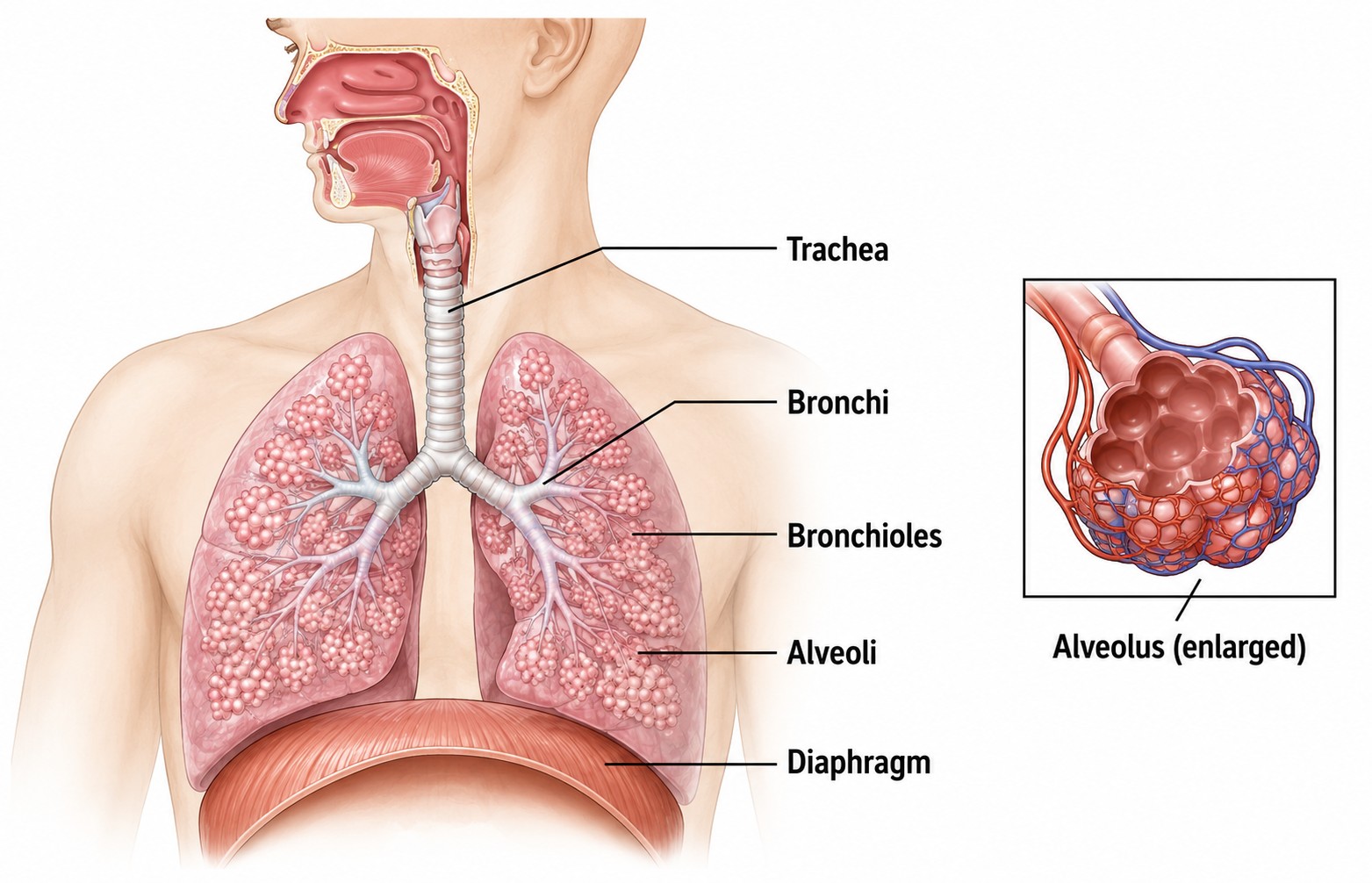
The image shows the human respiratory system. Which structure is the primary site of gas exchange?
Question image
ABronchi
BLarynx
CAlveoli
DTrachea
Explanation
Gas exchange (O₂ ↔ CO₂) happens at the alveoli, where their thin walls allow gases to diffuse between air and capillary blood.
Question 2 of 10
TEKS 5A-11BEasy Image

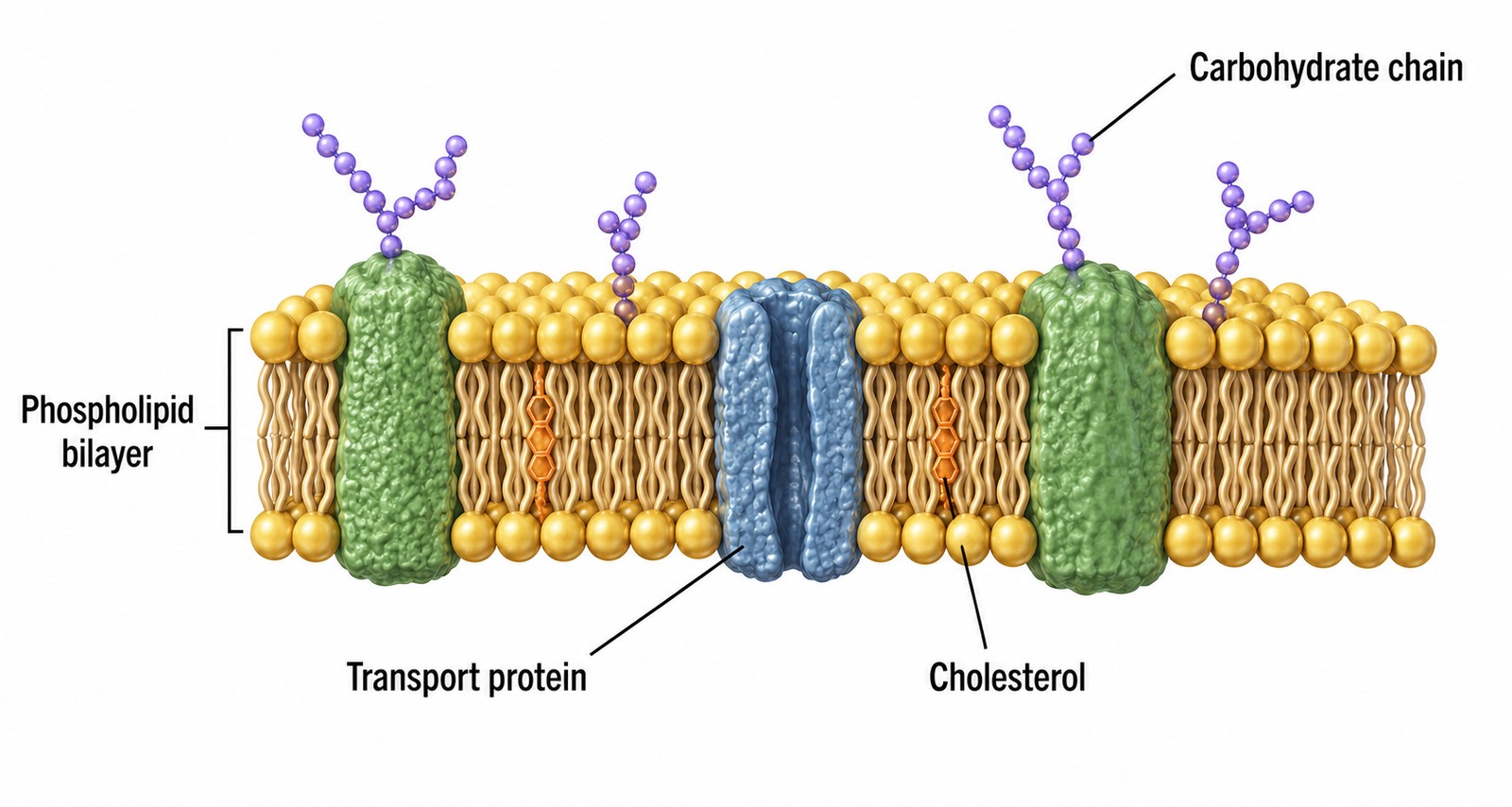
The diagram shows a cell membrane. Which feature gives it selective permeability?
Question image
AThe nucleus inside the cell
BA solid wall of carbohydrates
CA single layer of fat molecules
DThe phospholipid bilayer with embedded transport proteins
Explanation
The cell membrane consists of a phospholipid bilayer with embedded proteins (channels, pumps) that selectively allow molecules through. It is not a solid carbohydrate wall, not a single layer of fat, and the nucleus is a separate structure inside the cell, not part of the membrane.
Question 3 of 10
TEKS 12A-12BMedium

How do the pulmonary and systemic circuits of the human circulatory system differ?

AThe pulmonary circuit serves the lungs; the systemic serves the rest of the body
BThe pulmonary circuit serves the body; the systemic circuit serves only the lungs
CThe two circuits operate independently, with separate hearts driving each
DThe pulmonary circuit carries only oxygenated blood in both directions
Explanation
Blood leaves the right ventricle for the lungs, returns oxygenated to the left atrium, and is then pumped out to the body — two loops in series through one four-chambered heart. Note the pulmonary ARTERY carries deoxygenated blood, the one place where the usual rule reverses.
Question 4 of 10
TEKS 12A-12BMedium

Where in the lungs does gas exchange actually take place, and why there?

AIn the alveoli, whose thin walls and huge area speed diffusion
BIn the diaphragm, whose contraction draws the air inward
CIn the trachea, which warms and filters the incoming air
DIn the bronchi, whose cartilage rings hold the airway wide open
Explanation
The alveoli present a vast surface — roughly the area of a tennis court — one cell thick and wrapped in capillaries, which is exactly the geometry diffusion needs. Everything upstream is plumbing: the trachea and bronchi conduct and condition the air but exchange no gas.
Question 5 of 10
TEKS 5A-11BMedium Word Diagram
Which arrow in the diagram represents cellular respiration? ChloroplastGlucoseMitochondriaATPABCO₂ ⇄ CO₂D
AArrow A
BArrow B
CArrow C
DArrow D
Explanation
📌 Arrow D represents cellular respiration:
Glucose enters mitochondria → broken down → ATP produced

A = light energy absorbed
B = photosynthesis (makes glucose)
D = cellular respiration (makes ATP)
Question 6 of 10
TEKS 7A-8AMedium Diagram

If one strand of DNA reads 5′-ATCG-3′, what is the complementary strand?

A−TG−CA−TC−Gsugar-phosphatebackbone
A5′-TAGC-3′
B5′-AUCG-3′
C3′-ATCG-5′
D3′-TAGC-5′
Explanation
Complementary strand pairs A↔T, T↔A, C↔G, G↔C and runs antiparallel: 3′-TAGC-5′.
Question 7 of 10
TEKS 1A-4BMedium Diagram
A graph shows enzyme activity rising from 0 °C to a peak at 37 °C and falling sharply to zero at 60 °C. What best explains the fall after 37 °C?
02040600255075100temperature (°C)enzyme activity (%)Enzyme activity against temperature
AThe reaction reverses direction above the optimum
BThe enzyme is used up as the reaction proceeds
CThe substrate freezes at the higher temperatures
DThe enzyme denatures and its active site changes
Explanation
Heat above the optimum breaks the bonds holding an enzyme in shape. Once the active site no longer fits the substrate, activity collapses.
Question 8 of 10
TEKS 7A-8AHard

CRISPR-Cas9 gene editing uses a guide RNA to direct the Cas9 enzyme to a specific DNA sequence, where Cas9 creates a double-strand break. The cell's own repair machinery then fixes the break, sometimes introducing changes (like small insertions/deletions) at that site. What determines WHERE in the genome the edit occurs?

ACas9 cuts DNA entirely at random locations throughout the genome regardless of any guide RNA sequence used — a distortion that swaps the actual cause and effect described in this situation
BThe guide RNA has no influence on cut location; only the specific cell type determines where Cas9 acts — an assumption that does not hold once the actual details of this scenario are considered
CThe sequence of the guide RNA, which is designed to be complementary to the specific target DNA sequence, directs Cas9 to cut at that location and nowhere else (barring off-target effects)
DThe target location is determined solely by which chromosome is physically closest to the cell's nuclear membrane — a common mix-up that mistakes a related but distinct concept for what is actually happening
Explanation
The guide RNA's sequence is designed to base-pair with a specific complementary target sequence in the genome; this base-pairing is what directs the Cas9 enzyme to cut at that precise location (with a nearby PAM sequence also required), giving CRISPR-Cas9 its site-specific gene-editing precision, unlike older, less targeted approaches.
Question 9 of 10
TEKS 1A-4BHard Diagram
A graph shows bacterial population against time on a logarithmic vertical axis, and the exponential-growth phase appears as a straight line. The line is straight because — 10²10³10⁴10⁵straight stretchtimepopulation (log scale)each labelled step up the axis is ten times the last
Athe logarithm compresses very large values while leaving small values unchanged
Beach equal interval of time multiplies the population by the same fixed factor
Cthe population grows by a fixed number of cells during each interval of time
Dbacteria divide at a rate that slows steadily as the population becomes larger
Explanation
A constant multiplicative rate becomes a constant additive rate once logged, and a constant additive rate plots as a straight line.
Question 10 of 10
TEKS 12A-12BHard

A person's kidneys lose the ability to reabsorb glucose. What is the most direct consequence?

ABlood glucose rises steadily because none of it can leave the blood
BThe person produces far less urine than they normally would
CInsulin release stops, since the pancreas detects no glucose at all
DGlucose appears in the urine even when blood sugar is normal
Explanation
A healthy nephron filters glucose out of the blood and then reabsorbs essentially all of it. Remove the reabsorption step and the filtered glucose is lost in the urine regardless of blood level. Because glucose in the tubule holds water osmotically, urine volume RISES rather than falls — which is why untreated diabetes causes both thirst and frequent urination.

Score
Correct
Wrong
Try Again Exit