What is the largest prime factor of 2024?
Explanation
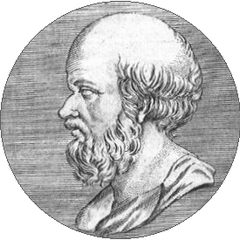 Eratosthenes of Cyrenec. 276–194 BC · Mathematician“Sift the numbers, and the primes remain.”
Strip the small primes off one at a time and watch what is left:
2024 = 2 · 1012 = 22 · 506 = 23 · 253.
Now 253 is odd, and it is not divisible by 3 (its digits sum to 10) or by 5 or 7. Trying 11 gives 253 = 11 · 23. Both factors are prime, so the complete factorization is
2024 = 23 · 11 · 23.
The largest prime factor is 23. Two traps sit close by: 253 is a factor of 2024 but is not prime, and 11 is prime but not the largest. Once a quotient drops below the square of your trial divisor, whatever remains is itself prime — that is why the search stops so quickly.
What is the remainder when 3<sup>100</sup> is divided by 100?
Explanation
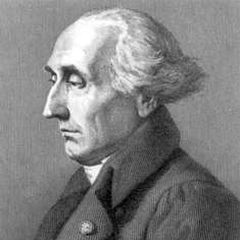 Joseph-Louis Lagrange1736–1813 · Mathematician“When we have grasped the whole, the parts explain themselves.”
Do not compute 3100. Ask instead how long it takes the powers of 3 to return to 1 modulo 100 — that period governs everything.
32 = 9, 34 = 81, 35 = 243 ≡ 43, 310 ≡ 432 = 1849 ≡ 49, and 320 ≡ 492 = 2401 ≡ 1 (mod 100).
So the order of 3 modulo 100 is 20. Since 100 = 20 × 5,
3100 = (320)5 ≡ 15 = 1 (mod 100).
The last two digits of 3100 are 01. Note the economy: once a power returns to 1, every multiple of that exponent returns to 1 as well. Squaring your way up (35 → 310 → 320) costs three multiplications, not ninety-nine.
A nonzero real number <em>x</em> satisfies <em>x</em> + 1/<em>x</em> = 5. What is the value of <em>x</em><sup>3</sup> + 1/<em>x</em><sup>3</sup>?
Explanation
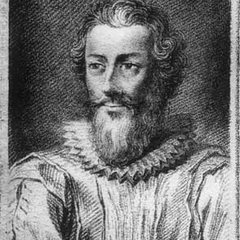 François Viète1540–1603 · Mathematician“There is no problem that cannot be solved.”
Do not solve for x. The expression is symmetric in x and 1/x, so it must be expressible through the quantity we already know. That is the whole art.
Cube the given sum:
(x + 1/x)3 = x3 + 3x + 3/x + 1/x3 = x3 + 1/x3 + 3(x + 1/x).
Substitute the known value 5 on the left and on the right:
53 = x3 + 1/x3 + 3·5, so 125 = x3 + 1/x3 + 15.
Therefore x3 + 1/x3 = 110.
The tempting error is to answer 125 — forgetting that cubing a sum leaves behind the cross term 3(x + 1/x), which must be subtracted away.
At exactly 3 o’clock the hour hand points at 3 and the minute hand at 12. How many minutes later do the two hands first point in exactly the same direction?
Explanation
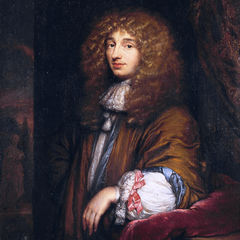 Christiaan Huygens1629–1695 · Mathematician & Physicist“The value of a chance is what one ought to pay to hold it.”
Both hands sweep at constant rates, so this is a pursuit along a circle. Measure angles clockwise from 12 and count degrees.
The minute hand turns 360° in 60 minutes: 6° per minute.
The hour hand turns 360° in 12 hours: 0.5° per minute.
At 3 o’clock the hour hand is at 90° and the minute hand at 0°. After t minutes:
minute hand: 6t. hour hand: 90 + 0.5t.
They coincide when 6t = 90 + 0.5t, so 5.5t = 90 and
t = 90/5.5 = 180/11 minutes ≈ 16 min 21.8 s.
The relative speed 5.5° per minute is the whole idea: the minute hand does not chase a stationary target. Answering 15 assumes the hour hand waits at 3; the true answer must exceed 15, and 180/11 ≈ 16.36 does.
How many positive integers <em>n</em> with <em>n</em> ≤ 100 leave a remainder of 2 when divided by 5 and a remainder of 3 when divided by 7?
Explanation
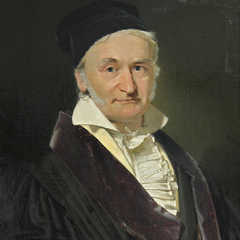 Carl Friedrich Gauss1777–1855 · Mathematician“Mathematics is the queen of the sciences, and number theory is the queen of mathematics.”
Two remainder conditions at once — this is exactly the situation my congruences were built for. Write them as n ≡ 2 (mod 5) and n ≡ 3 (mod 7).
Start from the second condition, since it is the more restrictive of the two: the candidates are 3, 10, 17, 24, 31, … Now test each against n ≡ 2 (mod 5). The first to succeed is 17, because 17 = 3·5 + 2 and 17 = 2·7 + 3.
Once a single solution is found, every other solution differs from it by a multiple of the least common multiple of the two moduli. Since 5 and 7 are coprime, that period is 35. So the full solution set is n ≡ 17 (mod 35): 17, 52, 87, 122, …
Of these, only 17, 52 and 87 do not exceed 100. The count is 3.
Note how the answer depends on the period 35, not on the individual moduli. Had the moduli shared a factor, the system might have had no solution at all.
In triangle <em>ABC</em>, <em>AB</em> = 13, <em>BC</em> = 14 and <em>CA</em> = 15. What is the length of the altitude drawn from <em>A</em> to side <em>BC</em>?
Explanation
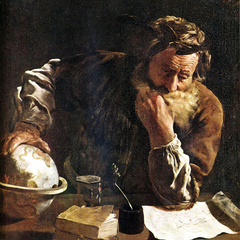 Archimedes of Syracusec. 287–212 BC · Mathematician & Engineer“Give me a place to stand, and I shall move the Earth.”
An altitude is nothing but the area seen from a different side. Find the area once, and the altitude falls out.
The semiperimeter is s = (13 + 14 + 15)/2 = 21. Then
Area = √[21(21−13)(21−14)(21−15)] = √(21·8·7·6) = √7056 = 84.
Now read the same area as ½ · base · height, taking BC = 14 as the base and the altitude h as the height:
84 = ½ · 14 · h, so 84 = 7h, and h = 12.
You may verify it by coordinates: place B at the origin and C at (14, 0). Then A = (5, 12), since 52 + 122 = 169 = 132 and 92 + 122 = 225 = 152. The height above BC is indeed 12.
Beware: had you used 15 as the base, the altitude would be 2·84/15 = 11.2 — a different altitude of the same triangle. The question names the side.
Starting at <em>A</em> and moving only one unit right or one unit up along the grid lines at each step, how many different paths lead from <em>A</em> to <em>B</em>?
Explanation
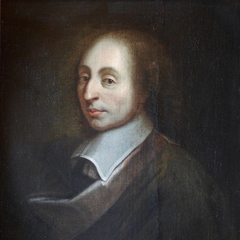 Blaise Pascal1623–1662 · Mathematician & Philosopher“Chance is tamed the moment we learn to count the ways.”
Every path is a word. Reaching B requires exactly 4 steps right and 3 steps up, in some order — no more, no fewer, since the grid is 4 wide and 3 tall.
So a path is nothing but an arrangement of the letters R R R R U U U, and two paths are different exactly when their words differ.
Choose which 3 of the 7 steps are the up-steps; the rest are forced:
C(7, 3) = (7 · 6 · 5)/(3 · 2 · 1) = 35.
Equivalently C(7, 4) = 35 — choosing the right-steps instead. The two counts must agree, and they do.
Counting ordered steps as distinct gives 7! / (4! 3!) — the same 35. But 7 · 6 · 5 = 210 without dividing by 3! treats the three identical up-steps as if they were labelled, and overcounts by a factor of six.
In right triangle <em>ABC</em> the right angle is at <em>B</em>, with <em>AB</em> = 9 and <em>BC</em> = 12. The bisector of angle <em>B</em> meets <em>AC</em> at <em>D</em>. What is the length of <em>BD</em>?
Explanation
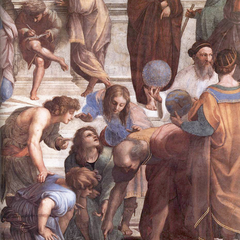 Euclid of Alexandriac. 300 BC · Mathematician“There is no royal road to geometry.”
Place the right angle at the origin and let the legs lie along the axes; then the bisector of that right angle is the line making equal angles with both — the line y = x. Coordinates turn the whole question into one intersection.
Let B = (0, 0), A = (0, 9), C = (12, 0). The line AC has intercept form x/12 + y/9 = 1, that is 3x + 4y = 36.
D lies on that line and on y = x. Substituting: 3x + 4x = 36, so 7x = 36 and D = (36/7, 36/7).
Therefore BD = √[(36/7)2 + (36/7)2] = (36/7)√2 = 36√2/7.
You may check the position of D against my bisector proposition: it must divide AC in the ratio of the adjacent sides, AD : DC = AB : BC = 9 : 12 = 3 : 4. The point (36/7, 36/7) does exactly that.
The distractor 36/7 is the answer to a different question — it is the coordinate of D, not the distance to it. The factor √2 is the diagonal you must not drop.
How many real numbers <em>x</em> satisfy (<em>x</em><sup>2</sup> − 3<em>x</em> + 1)<sup>(<em>x</em><sup>2</sup> − 5<em>x</em> + 6)</sup> = 1?
Explanation
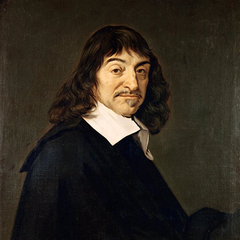 René Descartes1596–1650 · Mathematician & Philosopher“Divide each difficulty into as many parts as is feasible and necessary to resolve it.”
Divide the difficulty. A real power be equals 1 in exactly three circumstances, and I shall take them one at a time.
Case 1 — the base is 1. x2 − 3x + 1 = 1 gives x(x − 3) = 0, so x = 0 or x = 3. Any exponent will do.
Case 2 — the base is −1 and the exponent is an even integer. x2 − 3x + 2 = 0 gives x = 1 or x = 2. At x = 1 the exponent is 1 − 5 + 6 = 2, even — accept. At x = 2 the exponent is 4 − 10 + 6 = 0, even — accept.
Case 3 — the exponent is 0 and the base is not 0. x2 − 5x + 6 = 0 gives x = 2 or x = 3, and at both the base (−1 and 1) is nonzero — accept. Both were already found.
The union is {0, 1, 2, 3}: 4 real numbers.
Two errors are almost universal. Forgetting Case 2 loses x = 1. And double-counting x = 2 and x = 3, which each satisfy two cases at once, inflates the answer to 6. The cases overlap; the solutions must be collected, not added.
How many integers n with 1 ≤ n ≤ 1000 have the property that n² and n leave the same remainder when divided by 1000?