
A 4-Year Homeschool CBE Roadmap for Texas (Grades 9–12)


Texas homeschool families build their own four-year high-school plan — and Credit by Examination (CBE) (CBE) is one tool for documenting recognized course credits along the way. Under the Texas Supreme Court's unanimous (9-0) decision in Texas Education Agency v. Leeper (1994), Texas treats home schools as private schools, so a homeschool family is not legally bound to the state's Foundation High School Program (FHSP). Even so, many families choose to mirror the FHSP as a credibility benchmark for college admissions, and the parent or home school issues its own diploma and assembles its own transcript. This post is a sample multi-year roadmap to adapt — not a mandate, and not the same as our how-CBE-works guide. Here we focus on the grade-by-grade sequence.
First, the benchmark: the Foundation High School Program
Texas public-school graduates follow the Foundation High School Program. Homeschoolers are not required to meet it, but it is a widely-used reference many families mirror so a transcript looks familiar to colleges. The base program is 22 credits; the Distinguished Level of Achievement (DLA) is 26 credits.
| Area | Foundation (base): 22 credits | Distinguished (DLA): 26 credits |
|---|---|---|
| English Language Arts | 4 | 4 |
| Mathematics | 3 | 4 (must include Algebra II) |
| Science | 3 | 4 |
| Social Studies | 3 | 3 |
| Languages Other Than English (LOTE) | 2 | 2 |
| Physical Education | 1 | 1 |
| Fine Arts | 1 | 1 |
| Electives | 5 | 7 |
| Total | 22 | 26 (+ 1 endorsement) |
Mathematics typically includes Algebra I and Geometry; Science commonly includes Biology; Social Studies commonly includes U.S. History. The Distinguished Level of Achievement requires 4 math credits including Algebra II plus completion of one endorsement, and DLA is what makes a student eligible for the Top 10% automatic-admission policy at Texas public universities. Confirm the specific course requirements that apply to your student with your district and your target colleges.
Where CBE fits — and where it doesn't
CBE earns a specific course credit by exam. It is a strong fit for core academic courses, but it does not cover everything on the benchmark above. There are two routes:
- Route 1 — district-administered acceleration exams. Texas Education Code §28.023 requires districts to administer each board-approved exam at least four times a year, and these acceleration exams are offered at no charge. For acceleration with no prior instruction, the student must score 80% to earn credit.
- Route 2 — university CBE through UT High School (UTHS) or Texas Tech University ISD. These are fee-based (commonly around $50–$150 per exam, varying by year, subject, and provider). For a credit-by-exam with prior instruction, the passing score is 70% under TAC §74.24, and scores can be transferred to the home district with district permission.
Two important limits to plan around:
- CBE does not cover everything. It does not replace English/ELA, Physical Education, Fine Arts, Languages Other Than English (LOTE), or most electives. The family covers those through its own curriculum or other providers. CBE alone does not produce a diploma or satisfy all graduation requirements.
- Who records the credit. Only a school district records credit on a district transcript. On a parent-issued homeschool transcript, the family may list a CBE-validated course and keep the official score report as documentation.
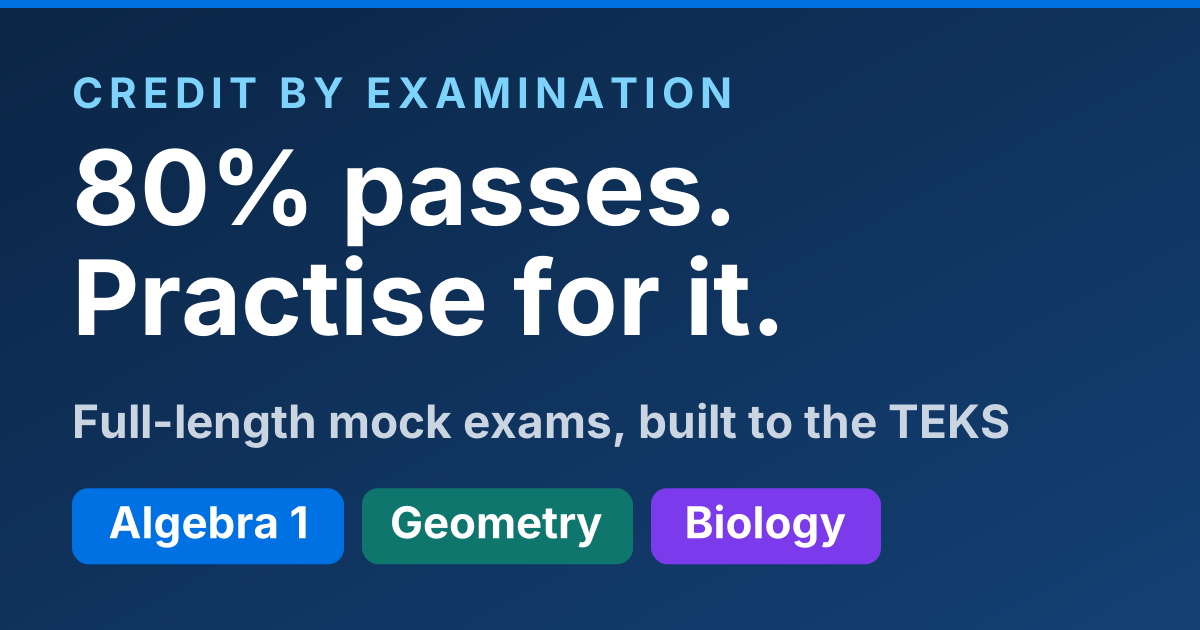
Credit by Examination asks for 80% with no prior instruction. Full-length mock exams written to the same TEKS the exam is drawn from — Algebra 1, Geometry, Biology, Chemistry and more.
See the subjects →
Every subject has free practice questions with the full worked solution. Take some and see whether they look like the exam your district set.
See the subjects →
Every Credit by Examination window we have verified from a district's own calendar — 22 districts, 75 windows, each with the source it came from.
See the deadlines →
Not a guess at what might be on it. Full worked solutions and timed mock exams built to the same TEKS the Credit by Examination is written against.
Browse the subjects →A sample Grade 9–12 CBE grid
Here is one suggested sequence for the core academic courses where CBE is a strong fit. Treat it as a sample to adapt, not a fixed schedule:
| Grade | Math (CBE) | Science / Social Studies (CBE) |
|---|---|---|
| Grade 9 | Algebra 1 | Biology (science) |
| Grade 10 | Geometry | Chemistry (science) |
| Grade 11 | Algebra 2 | U.S. History (social studies) |
| Grade 12 | Pre-Calculus (4th math credit) | SAT Math prep (college admissions — not a credit) |
A few notes on the grid:
- It builds toward the Distinguished math benchmark — four math credits including Algebra II — by reaching Pre-Calculus as the fourth math credit in Grade 12.
- A well-prepared student can accelerate. For example, testing Algebra 1 in 8th grade shifts the whole ladder a year earlier — that is acceleration, and it is allowed.
- You also take other courses each year. Alongside the math/science/U.S. History core shown here, the family covers English, additional science and social studies, LOTE, Physical Education, Fine Arts, and electives through its own curriculum.
- Sequence logic. Algebra 1 → Geometry → Algebra 2 → Pre-Calculus is the standard math progression, and Biology before Chemistry is typical. Adjust to your student's readiness.
How to actually do it each year
For each course on the plan, the yearly cycle is the same:
- Prepare. Work through the year's CBE course with TEKS-mapped practice and a full-length mock exam until your student is consistently at or above the passing threshold.
- Register. Choose Route 1 (a free district-administered acceleration exam, with no prior instruction, scored at 80%) or Route 2 (a paid UTHS or Texas Tech University ISD exam, with prior instruction, scored at 70% under TAC §74.24).
- Take the exam at the approved time and place.
- Keep the score report. The provider issues an official score report — keep it as your documentation.
- Record it on the transcript. A district records the credit on a district transcript; on a parent-issued homeschool transcript, list the CBE-validated course and keep the score report on file.
For the full step-by-step mechanics of a single exam, see our homeschool how-CBE-works guide. This roadmap is the multi-year plan that sits on top of it.
About the SAT Math note in Grade 12
SAT Math prep is in the Grade 12 row for a reason — and it is a different kind of item from the others. SAT Math is college-admissions preparation, not a CBE course credit. A strong SAT Math score can support a college application, but it does not go on a transcript as a course and does not earn high-school credit. Treat it as an admissions-prep add-on that pairs naturally with finishing the math sequence, not as a fifth credit.
How Texas CBE™ helps
Texas CBE™ is an independent practice platform built for the CBE path. It supports the seven CBE subjects in this roadmap:
- Math: Algebra 1, Geometry, Algebra 2, Pre-Calculus.
- Science: Biology, Chemistry.
- Social Studies: U.S. History.
For each subject we offer TEKS-mapped, CBE-style practice questions and full-length mock exams modeled after the official CBE format, with per-TEKS-category scoring and step-by-step explanations, plus free sample questions on every subject with no signup required. SAT Math practice (Digital SAT format) is available separately as admissions prep — not a CBE credit.
Full-course access is listed at $29.99 per CBE subject — typically less than a single university CBE retake fee. To be clear: we prep for the CBE, not the GED, and not the SAT itself beyond SAT Math practice.
→ Browse subjects and try free sample questions
This guide is based on publicly available information about Texas Credit by Exam, the GED/TxCHSE, and Texas homeschool law, and is for general information only — not legal or educational advice. Policies, fees, score requirements, and accepted providers vary by district and change over time. Always verify current requirements directly with your school counselor, your district's CBE coordinator, UT High School (UTHS), the Texas Education Agency (TEA), and your target colleges before making decisions. Texas CBE™ is an independent practice platform; it is not affiliated with, endorsed by, or operated by TEA, UTHS, Texas Tech University ISD, GED Testing Service, the College Board, or any school district, and it does not administer the CBE or grant academic credit.


