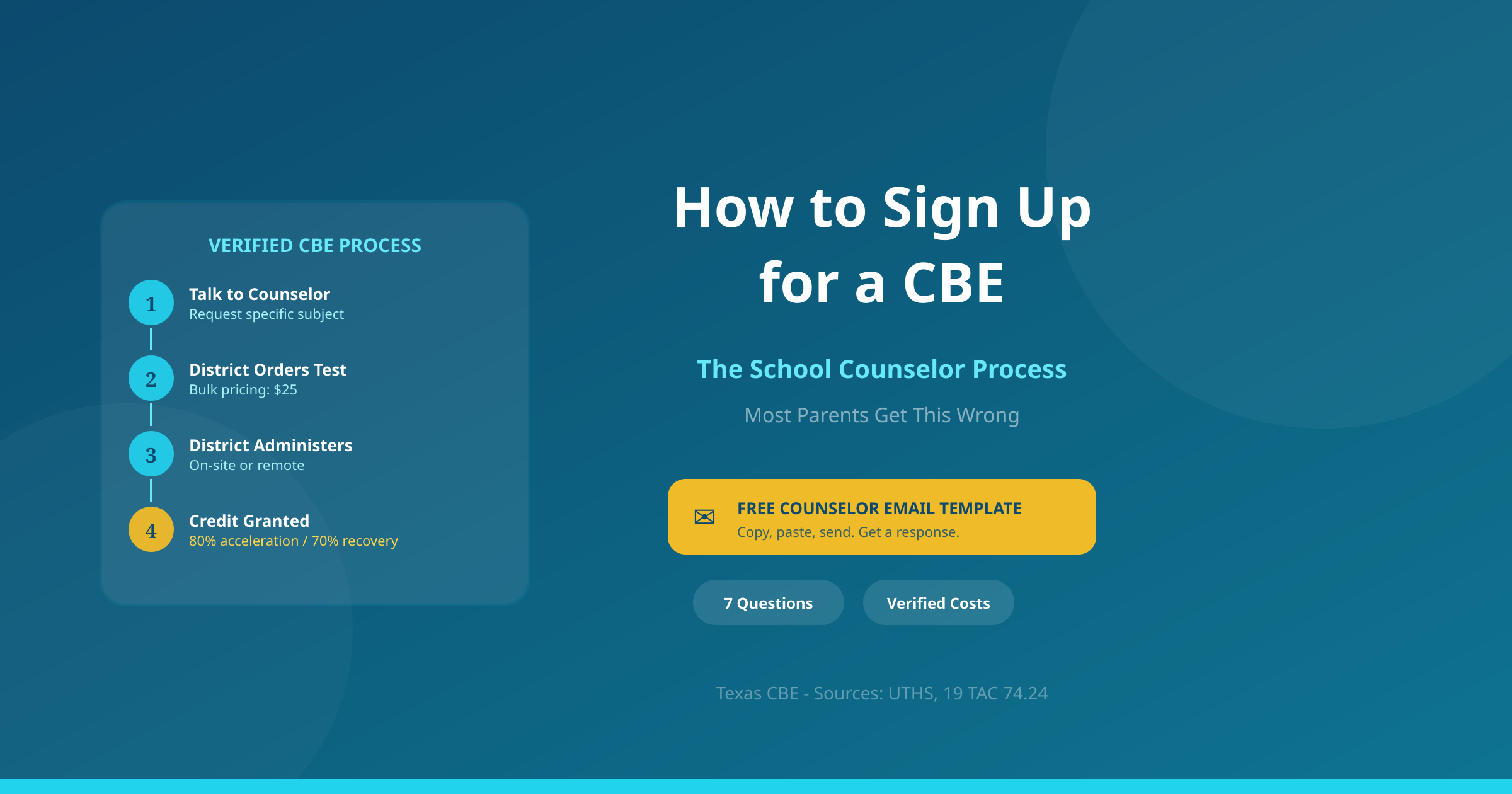
How to Ask Your Texas School About a CBE — A Parent's Script (Email, Questions, Documents)


Most Texas parents who hear about Credit by Exam (CBE) from a friend, a homeschool group, or a TikTok end up Googling for hours and still don't know exactly how to ask their school for it. The conversation can feel awkward, especially if your school counselor seems unfamiliar with the process. This guide gives you the exact words to use, the order to use them in, and what to do at each fork in the conversation.
We built Texas CBE™ specifically to help students prepare. This guide is free, independent, and works whether you use our practice or not.
Before you ask: a 60-second background
Texas has two separate paths for a student to earn high-school course credit by exam:
- Free district route (Texas Education Code §28.023 — "Credit by Examination for Acceleration"). Your child's school district administers the exam at no cost. The state code sets 80% as the passing threshold for acceleration (i.e., earning credit without taking the course). Districts are required by law to offer this at least four times a year.
- Paid UT High School (UTHS) route (19 TAC §74.24). An external CBE administered by UT Austin's high school. Most subjects use a 70% threshold for credit recovery (prior instruction) and 80% for acceleration (no prior instruction). Posted fees: $70 per individual exam (includes Proctorio remote proctoring for grades 3–12) or $25–$35 per district bulk-ordered exam. Most families pay the lower district rate through their school counselor; check UTHS for current pricing. K-2 exams are paper-only and must be taken on-site.
Many districts (e.g., Frisco ISD) explicitly require 80% for any CBE-based credit including UTHS scores. Some accept 70%. The first conversation with your school is about finding out exactly which standard applies in your district.
Who to email first — in order
- Your child's school counselor. Default first contact. They route to the right person 90% of the time.
- The campus "CBE coordinator" or "Advanced Academics coordinator." Larger high schools designate someone. Counselor can name them.
- District Advanced Academics / Gifted & Talented office. If campus-level says "we don't do that," go up one level.
- Principal or assistant principal. Last resort if you hit dead ends.
The email script (copy & adapt)
This is a tested template that signals you've already done your homework, which speeds the conversation up significantly:
Subject: Credit by Exam request — [Your child's name], [grade] grade
Hi [Counselor's name],
I'm [your name], parent of [child's name] in [grade]. I'd like to request information about Credit by Exam for [subject — e.g., Algebra 1, Geometry, US History].
Specifically, I'd like to understand:
- Which CBE routes [district name] supports — the free TEC §28.023 district CBE and/or UTHS §74.24.
- The passing-score threshold our district applies (70% or 80%).
- The next available test windows and registration deadline.
- Any documents we should prepare for the request.
Could we set up a 15-minute meeting in the next two weeks? I'm flexible on time.
Thank you,
[Your name] · [phone] · [child's school ID number]
Why this email works: you name the legal statutes (§28.023 and §74.24), which tells the counselor you know the process exists. You ask specific questions, not vague ones. You request a meeting with a concrete length and timeframe.
The 4 questions to ask at the meeting
- "What CBE routes does our district offer?" — Pin down whether they support both the free §28.023 district CBE and the paid UTHS §74.24. Some smaller districts only offer one.
- "What is our district's passing-score policy?" — 70% or 80%? Some districts apply different thresholds to different subjects. Get it in writing.
- "What's the next available test window, and what's the registration deadline?" — Most districts run CBE at least four times a year (typically a spring window in April/May and a fall window in October/November). Don't miss the registration cutoff — it can be 4–6 weeks before the actual exam.
- "What happens if our child passes? How does the credit appear on the transcript?" — This is the question that signals you understand the long-term picture. Credit by exam typically shows as "CBE" with no GPA impact (which is what most acceleration-track families want).
Credit by Examination asks for 80% with no prior instruction. Full-length mock exams written to the same TEKS the exam is drawn from — Algebra 1, Geometry, Biology, Chemistry and more.
See the subjects →
Every subject has free practice questions with the full worked solution. Take some and see whether they look like the exam your district set.
See the subjects →
Every Credit by Examination window we have verified from a district's own calendar — 22 districts, 75 windows, each with the source it came from.
See the deadlines →
Not a guess at what might be on it. Full worked solutions and timed mock exams built to the same TEKS the Credit by Examination is written against.
Browse the subjects →Documents to bring (or attach to the email)
- Your child's current class schedule (shows what they're not currently taking)
- Most recent report card or transcript
- Standardized test scores if relevant (NWEA MAP, STAAR, SAT/PSAT) — signals your child has the academic foundation
- If you have one, a printout of your district's CBE policy from its student handbook — many handbooks have a "Credit by Examination" section
- (Optional) A short, factual one-paragraph note explaining the academic rationale — "we'd like to accelerate to Algebra 2 this fall so the schedule supports Calculus by junior year"
What if the school says no?
You have more options than you think. Even if your campus counselor says "we don't do that here," the law is on your side for §28.023:
- The free district CBE is a legal right under TEC §28.023. Districts must offer it at least four times a year for any course in the required curriculum. They cannot refuse to administer it — though they can set the time, location, and exam they use.
- The UTHS paid route bypasses the district entirely for the exam itself. You enroll your student at UT High School (uths.utexas.edu) as an external student, take the CBE, and request the district add the credit to the transcript afterward. If the district refuses to add the credit, that's when you escalate — first to the district Advanced Academics office, then to the school board if needed.
- Some districts have unwritten "we discourage CBE" cultures. If yours is one, be polite but persistent. Reference the statute. Ask for the policy in writing. Most barriers crumble when parents calmly insist on what state law guarantees.
The realistic timeline
- Week 1: Email counselor. Reply usually comes within 3–5 days.
- Week 2–3: 15-minute meeting. Get the four answers in writing.
- Week 3–4: Register your child for the upcoming test window.
- Week 4 onward: Begin focused prep. (Our 6–month practice access is $29.99 per subject if that fits, but plenty of families succeed with just free public-domain practice + textbook review.)
- Test day: 3-hour exam at the district, at a UTHS-approved testing center, or at home via Proctorio (grades 3–12). Per UTHS: orders take up to 10 business days to process and scoring takes up to 20 business days after the exam.
- 2–4 weeks after: Score posted. If passed, credit added to transcript by counselor.
A few honest notes
- CBE doesn't replace the experience of taking a great class. It's a tool for students who already have the foundation, want to accelerate, or have a scheduling conflict. If your child is curious about the subject and enjoys learning it, the regular class may be more rewarding.
- Most colleges don't care about CBE credit specifically. They care about your child's overall trajectory: the highest math you reached, the consistency of grades, AP exam scores. CBE is a means to reach a higher math earlier — the GPA effect is neutral.
- Talk with your child first. If they're not motivated to study independently for 3–6 weeks, the exam is hard to pass. CBE assumes self-driven preparation.
If you'd like help preparing
Texas CBE™ offers free sample questions per subject (no signup needed) and full-length timed practice for $29.99 per subject (3 months). We're a small, independent platform built for Texas families, so we keep the cost close to what a single tutoring hour or one used study guide costs.
This guide is for general information only and is not legal or educational advice. Texas Credit-by-Exam policies, passing thresholds, and registration windows are set by individual school districts and the Texas Education Agency (TEA) and can change — always confirm specifics with your school counselor, the TEA, or your district's policy handbook. Texas CBE™ is an independent practice platform; it is not affiliated with, endorsed by, or operated by the Texas Education Agency, UT High School, Texas Tech University ISD, the College Board, or any school district, and it does not administer any exam or grant academic credit.