
Algebra 1 in Texas: The Gateway Math Course — Why It Matters and How to Get Ahead


If there's one course that shapes a Texas student's entire high-school math path, it's Algebra 1. It's foundational, it's state-tested, and it's the subject families most often test out of early to get ahead. Here's where it sits in Texas, why it matters so much, and how to start — free.
Where Algebra 1 sits in Texas
- Foundational & required. Algebra 1 is a required course on the path to a Texas diploma and is usually taken in 8th or 9th grade.
- A STAAR End-of-Course (EOC) subject. Algebra 1 is one of the five Texas STAAR EOC tests — so the state already treats it as a milestone course.
- The gateway to the whole math ladder. Everything after it builds on it: Algebra 1 → Geometry → Algebra 2 → Pre-Calculus → Calculus.
- Defined by the §111.39 TEKS — the Texas standards that spell out exactly what Algebra 1 covers (linear & quadratic functions, systems, exponentials, and more).
Why it matters so much
Algebra 1 is the gatekeeper to advanced math and STEM. Where a student lands in Algebra 1 tends to set the rest of the trajectory:
- Mastering it early opens the door to the accelerated / honors track and, ultimately, calculus before graduation.
- Gaps here cascade — Geometry, Algebra 2, and beyond all assume Algebra 1 fluency.
- It's a core college-readiness signal on the transcript.
| Because so much rides on it, Algebra 1 is also the course Texas families most commonly choose to test out of (accelerate) — moving a strong student up a level instead of repeating material they already know. |
Why so many Texas students take the exam
Algebra 1 is the #1 acceleration subject in Texas Credit by Exam. A common pattern: a strong student studies over the summer and tests out of Algebra 1 to jump straight into Geometry (or an honors track) in the fall. Texas allows this through Credit by Exam (CBE) — score 80% to earn credit with no prior instruction, 70% with prior instruction; year-long courses are usually split into a Semester A and a Semester B exam, and your school district records the credit.
For the full mechanics — exam format, the §111.39 TEKS by semester, and the topics students underestimate — see our complete Algebra 1 CBE guide, and how it fits the bigger picture in the Texas math acceleration ladder.
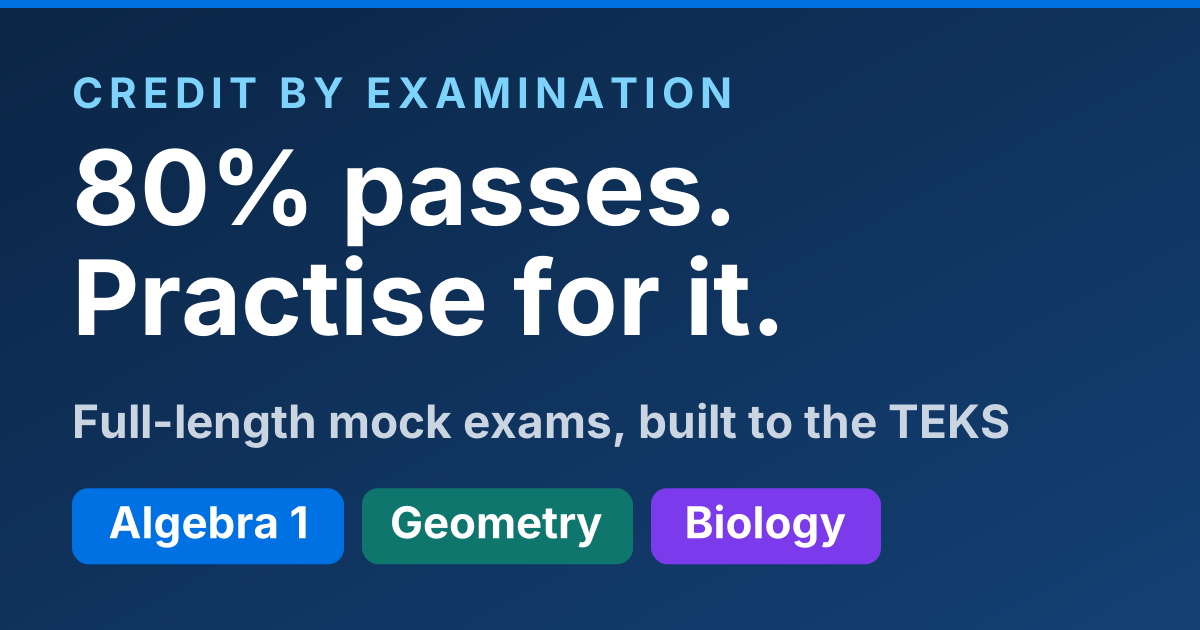
Credit by Examination asks for 80% with no prior instruction. Full-length mock exams written to the same TEKS the exam is drawn from — Algebra 1, Geometry, Biology, Chemistry and more.
See the subjects →
Every subject has free practice questions with the full worked solution. Take some and see whether they look like the exam your district set.
See the subjects →
Every Credit by Examination window we have verified from a district's own calendar — 22 districts, 75 windows, each with the source it came from.
See the deadlines →
Not a guess at what might be on it. Full worked solutions and timed mock exams built to the same TEKS the Credit by Examination is written against.
Browse the subjects →Start free: our Algebra 1 lessons
You don't need to pay anything to begin. Our /learn area has free, plain-English Algebra 1 lessons that map to the TEKS — a great way to gauge where your student stands. A few to start with:
- Linear Equations — the five-step method that solves every "find x"
- Slope & Linear Graphs — rise over run, three equation forms
- Quadratic Functions — parabolas, vertex form, and the quadratic formula
- Functions & Notation — f(x), domain, range, and the vertical-line test
- Polynomials & Factoring — FOIL, GCF, and the three patterns
- Algebra 1 — Essential Formulas (quick reference)
When you're ready to prepare for the exam
Texas CBE™ is an independent practice platform built for the CBE format. For Algebra 1 we offer TEKS-mapped practice questions and full-length mock exams modeled after the official CBE format, with free sample questions on every subject (no signup required) so you can try before you decide. Full-course access is $29.99 — typically less than a single university CBE retake fee.
This guide is based on publicly available information about Texas graduation requirements and Credit by Exam and is for general information only — not legal or educational advice. Requirements, course placement, fees, testing windows, and passing rules vary by district and provider and change over time. Always verify the specifics with your school counselor and your district's Credit-by-Exam coordinator. Texas CBE™ is an independent practice platform; it is not affiliated with, endorsed by, or operated by the Texas Education Agency (TEA), UT High School, Texas Tech University ISD, the College Board, or any school district, and it does not administer the CBE or any exam, or grant academic credit.


