
Texas CBE Passing Scores and Retake Rules — What Students Need to Know (2026)


The Texas Credit by Examination (CBE) (CBE) can earn high-school credit in a single sitting — but only if your student clears the passing threshold for the right CBE pathway. Texas law actually defines two different CBE pathways with two different passing thresholds, and most confusion about "what score is passing?" comes from mixing them up.
New: not sure which deadline applies to your district? See our district-by-district CBE deadline guide for the full structure and real examples.
1. The two CBE pathways and their thresholds
Texas Education Code §28.023 and Texas Administrative Code §74.24 together create two CBE pathways:
When is your district’s deadline? Every district sets its own, and most close weeks before the test. The Texas CBE district portal counts down to the next one in each district, and the 2026–2027 schedule by district lists the full year.
- Credit by exam without prior instruction (acceleration). A student who has not formally taken the course tests out for full credit. Under TEC §28.023(c), the student must score 80% or higher on a criterion-referenced examination.
- Credit by exam with prior instruction (credit recovery). A student who previously failed or did not complete a course can use a CBE to earn the credit. Under TAC §74.24, the student must score 70% or higher.
The exam itself does not always announce which pathway it falls under. The pathway depends on the student's academic history and the way the campus or testing provider has registered the attempt — so it is important to confirm with your campus counselor which threshold applies to your student's specific attempt before exam day.
2. How UT High School (UTHS) handles thresholds
UT High School publishes a passing threshold on the score-report page for each individual exam it administers. Some UTHS exams target the acceleration pathway and use the 80% standard; others target credit recovery and use 70%. Always verify the threshold on the official UTHS page for the specific course code before registering — the figure is set by UTHS per exam, not by your district and not by us.
3. Typical exam format
Most CBE exams are roughly 50–60 multiple-choice questions, sometimes including grid-in math problems and short-response items, with a total time limit of around 3 hours. Exact length, item types, and time vary by subject and provider — the official course-specific page is always authoritative.
4. What does the score report look like?
The official score report typically includes:
- The raw percentage score
- Whether the student passed or did not pass the applicable threshold
- Sometimes a breakdown by TEKS category showing performance per domain (useful for retake prep)
- The exam date and subject
The score report becomes the document the campus uses to record credit on the high-school transcript.
5. What happens if a student doesn't pass?
- No credit is awarded for that attempt. The score is still reported but the credit doesn't transfer.
- A retake is generally allowed. Timing rules vary by subject, by provider, and by district. A common practical pattern at many districts is a waiting period of at least 30 days before retesting in the same subject; some require additional course remediation before allowing a retake.
- The retake costs another exam fee. Current UTHS fees and district-administered fees vary year to year — check the official fee page on the provider's site before registering. A failed retake doubles the out-of-pocket cost.
This is why we strongly recommend students take full-length, timed mock exams at home and consistently score comfortably above the applicable threshold (a 10–15 percentage-point cushion over the 70% or 80% line) before booking the official CBE. The cushion protects against test-day variance.
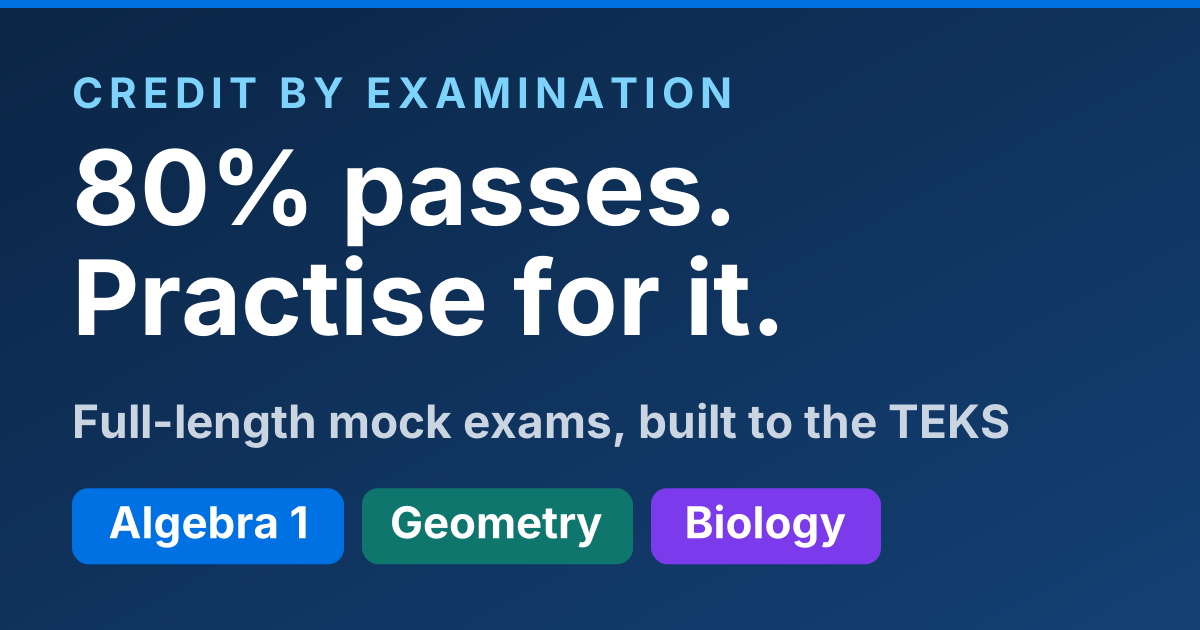
Credit by Examination asks for 80% with no prior instruction. Full-length mock exams written to the same TEKS the exam is drawn from — Algebra 1, Geometry, Biology, Chemistry and more.
See the subjects →
Every subject has free practice questions with the full worked solution. Take some and see whether they look like the exam your district set.
See the subjects →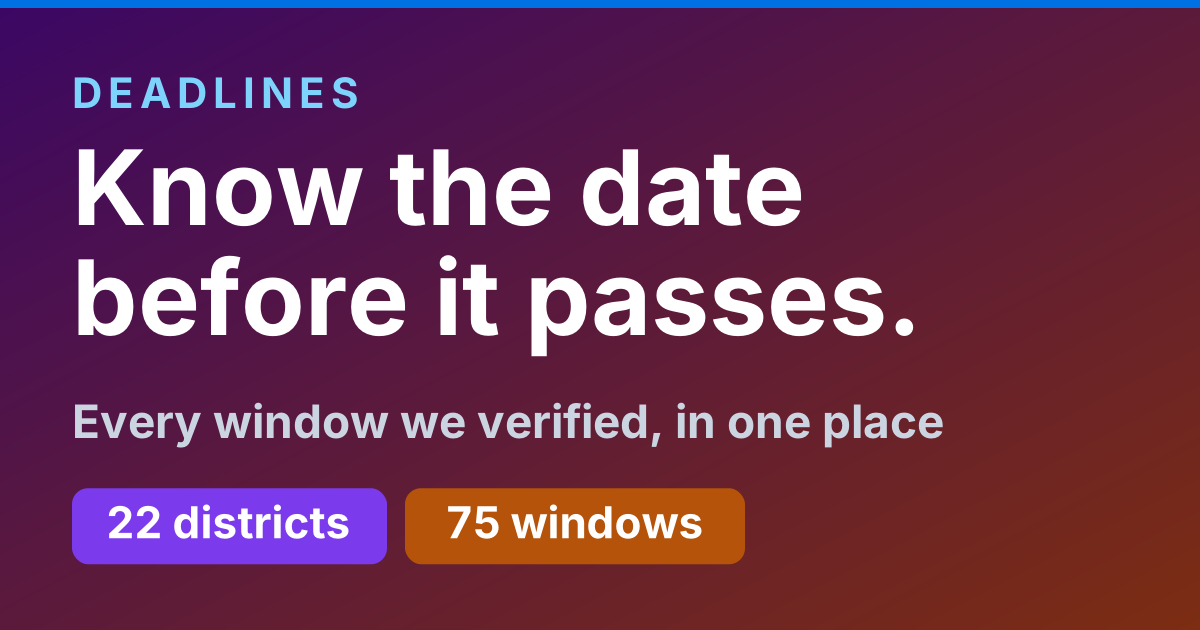
Every Credit by Examination window we have verified from a district's own calendar — 22 districts, 75 windows, each with the source it came from.
See the deadlines →
Not a guess at what might be on it. Full worked solutions and timed mock exams built to the same TEKS the Credit by Examination is written against.
Browse the subjects →6. How do retakes work logistically?
Retake mechanics vary district by district. Common patterns:
- Same exam window. Some districts schedule retakes within the same semester so the student doesn't lose a school year.
- Waiting period. Many districts and providers require at least 30 days between attempts in the same subject.
- Limit on number of attempts. Many districts cap CBE attempts per subject before requiring the student to take the actual course.
- Mandatory remediation. Some districts require evidence of additional study (tutoring, courseware, or formal coursework) before allowing a retake.
Always check the exact retake policy with your campus counselor before registering for the first exam — knowing the rules upfront helps you plan.
7. How long does the score take to show up?
UTHS typically reports CBE scores within roughly 2–4 weeks after the exam date, sometimes faster for purely multiple-choice subjects and slower when written or graded portions are involved. Districts then take additional time to record the credit on the transcript — often 1–2 more weeks, sometimes longer at the end of a semester or during summer breaks. Specific turnaround times vary.
Plan around this if you're using CBE to satisfy a graduation deadline. Don't take the CBE in May expecting the credit on a June transcript without confirming with your campus counselor that the timeline is realistic.
8. Practical prep strategy
Most students who pass on the first attempt do two things in their prep:
- Identify weak TEKS categories early. Don't just practice the categories you find easy. Use sample questions to find your blind spots within the first week.
- Take at least 2 full-length timed mock exams before the real CBE. Timing pressure is half the battle. Practicing one question at a time doesn't prepare a student for 3 hours of sustained focus.
Texas CBE™ supports both: free sample questions on every subject to find weak spots, and unlimited timed mock exams in the paid course ($29.99 for 3 months of access — typically less than a single retake fee).
Worried about hitting 70% (UTHS) or 80% (district)? Pulling a free sample is the fastest way to know where you stand. Try Algebra 1, Geometry, Biology, Algebra 2, Chemistry, or U.S. History — no signup. Scoring 85%+ cold on the sample is a good sign you're tracking well.
Wondering how CBE credit appears on the transcript, affects GPA, and is read by Texas colleges? See our CBE Credit on the Transcript — How Texas Colleges Read It guide.
Just got a score that came up short? Read What Happens If You Fail a CBE Test in Texas? — what it means, whether you can retake, and a calm plan to pass the next attempt.
Passing-score thresholds, retake timing, fees, and credit-recording procedures are set by the Texas Education Code, the Texas Administrative Code, individual testing providers (such as UT High School), and individual Texas school districts and campuses. Specifics change over time. Texas CBE™ is an independent practice platform and is not affiliated with, endorsed by, or sponsored by the Texas Education Agency, UT High School, or any Texas school district. Always verify the current rules and requirements with your campus counselor and the official UTHS / district sources before registering for any exam.
Frequently Asked Questions
What is the passing score for Texas CBE?
Can I retake a Texas CBE?
Does the CBE score replace my classroom grade?
What happens if I don't pass the CBE?
Does the school district have to allow CBE?
Is the CBE free?
- Texas Education Code §28.023 — Acceleration via Credit by Examination, 80% threshold
- 19 TAC §74.24 — Credit by Examination — prior instruction route, 70% threshold
- UT High School (UTHS) — University of Texas High School — primary CBE provider for Texas districts
- Texas Education Agency (TEA) — State agency that publishes TEKS and STAAR rules


