
Texas Charter Schools & Credit by Exam: A 101 Intro for Students and Parents


If your student attends a Texas public charter school — KIPP, IDEA, Harmony, Uplift, BASIS, Responsive Ed, International Leadership of Texas, or any of the dozens of others — Credit by Examination (CBE) (CBE) is available to them the same way it is to students at traditional Texas ISDs. The Texas statutes governing CBE apply uniformly to public schools, and public charters are public schools. But the day-to-day practice — when CBEs are scheduled, which subjects your charter actively administers, and which counselor you talk to — varies by network and even by campus.
This is a quick intro for families who are new to CBE and want to know how it fits at a charter school.
(This is an overview, not legal advice. Always confirm current charter and CBE specifics with your campus counselor or CBE coordinator before relying on this.)
Charter schools are public schools — same CBE statutes apply
In Texas, an "open-enrollment public charter school" is a public school governed by Texas Education Code Chapter 12. Charter students are public-school students for purposes of the CBE statutes. That means:
- Free district CBE (Texas Education Code §28.023): Texas public schools — including public charters — must offer Credit by Exam to enrolled students at no cost, with passing set at 80%. Your charter school is required to administer or arrange the CBE for you.
- Paid UTHS CBE (Texas Education Code §74.24 / 19 TAC): Any student — charter, ISD, homeschool — can take UT High School's CBEs for a fee, with passing set at 70%.
So a charter student has the same two routes a traditional ISD student has. What differs is the logistics, not the legal framework.
What's actually different at a charter
The wrinkles come from how each charter network operates:
- Scheduling windows. A large ISD might offer district CBEs three times a year on fixed dates. A smaller charter campus might offer them once a semester, or on request. Ask your counselor for the next CBE window early — if you miss it you may wait months.
- Which subjects your campus actively administers. By law, charters must offer CBEs across the high-school curriculum, but in practice some campuses are more streamlined for certain subjects (Algebra 1, Geometry, U.S. History) than others (e.g., specific science or world-language courses). If your charter doesn't have a smooth process for the subject you want, the UTHS paid route is the reliable fallback — UTHS administers CBEs across the high-school catalog year-round.
- Internal acceleration policies. Networks like KIPP, IDEA, and BASIS are known for academic rigor and acceleration culture, so they often have well-defined CBE pathways for students who want to skip ahead. Other networks may default to "stay on the track" and require more justification. Read your charter's student handbook or ask the counselor directly.
- Where it appears on the transcript. CBEs that your charter administers appear on the charter's transcript. UTHS CBEs appear on a UTHS transcript and need to be requested when applying to college or transferring schools. Both are accepted Texas-accredited credits.
Credit by Examination asks for 80% with no prior instruction. Full-length mock exams written to the same TEKS the exam is drawn from — Algebra 1, Geometry, Biology, Chemistry and more.
See the subjects →
Every subject has free practice questions with the full worked solution. Take some and see whether they look like the exam your district set.
See the subjects →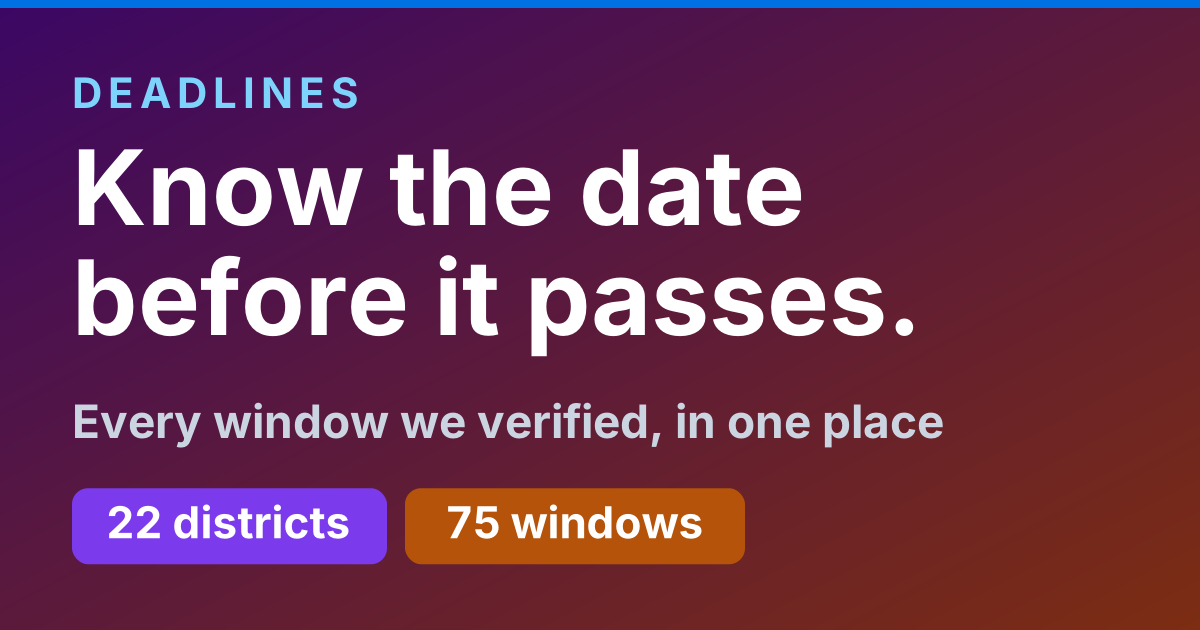
Every Credit by Examination window we have verified from a district's own calendar — 22 districts, 75 windows, each with the source it came from.
See the deadlines →
Not a guess at what might be on it. Full worked solutions and timed mock exams built to the same TEKS the Credit by Examination is written against.
Browse the subjects →When does it make sense to use CBE at a charter?
The four most common scenarios:
- Acceleration. Test out of Algebra 1 in 8th grade to start Geometry early and stay on a Pre-Calculus/Calculus track. (See our math acceleration guide.)
- Schedule pressure. Free up a high-school slot for a course you actually want (AP, dual credit, electives) by clearing a required course via CBE.
- Course not offered. If your charter doesn't offer a specific course you need for graduation or for college, CBE (district or UTHS) can supply the credit without re-enrolling elsewhere.
- Recovery. If a student didn't pass a course but knows the material, a CBE retake can earn the credit without repeating the whole class.
How most charter families use CBE in practice
- Talk to your counselor early. Confirm the subject, the route (district free vs UTHS paid), the next available test window, and the passing score (80% vs 70%) before committing.
- Study with TEKS-aligned material. The TEKS (Texas Essential Knowledge and Skills) is the same content framework regardless of your school. Charter networks teach to it. Independent practice that targets the same TEKS prepares for the same CBE.
- Prep with full-length practice close to the test. Our independently-authored CBE-format practice mirrors the official Texas CBE format (multiple choice, full length, timed) with worked explanations on every question.
- Register and sit the CBE — either through your charter's CBE coordinator or directly with UTHS.
- Confirm credit on the transcript after results post. Charter-administered credit goes on the charter transcript; UTHS credit needs a UTHS transcript request.
How we help
Texas CBE™ is an independent practice platform. We don't administer the test — that's TEA, your charter, or UTHS — but we build the high-volume, full-length, timed practice that turns a "covered the material" student into a "pass-the-exam" student. Subjects covered: Algebra 1, Geometry, Algebra 2, Pre-Calculus, Biology, Chemistry, U.S. History, SAT Math, and Earth Science, each mapped to the TEKS where applicable, with worked explanations and free sample questions on every subject.
Try it free
Start with free sample questions on any subject (no signup needed). Full-length mock-exam access is $29.99 for 3 months per subject — about the cost of a snack run and much less than a single CBE retake fee in many districts.
This article is for general information only and is not legal or educational advice. Texas charter-school CBE eligibility, administration practices, scheduling windows, UTHS policies, costs, and passing standards are set by the state, charter operators, and providers and change over time — always verify the current specifics with your charter's CBE coordinator, UT High School, or your school counselor. Texas CBE™ is an independent practice platform; it is not affiliated with, endorsed by, or operated by the Texas Education Agency (TEA), UT High School, Texas Tech University ISD, the College Board, or any school district, charter network, or homeschool association, and it does not administer any exam or grant academic credit.


