
Diagnose First, Then Focus: Why Starting CBE Prep Early Beats Last-Minute Cramming


Here's a pattern we see constantly. A student signs up, tries a few free questions, and thinks: "I'll study on my own for now. When the exam gets close, I'll start doing full practice tests like the real thing." Parents think it too — they wait until the test date is near before getting serious.
It feels responsible. It's also the single most common reason students walk into a Texas Credit by Exam (CBE) underprepared. This post explains why — using what cognitive science actually knows about how people learn — and gives you a concrete plan to do it better.
1. The "illusion of competence"
When you re-read your notes or watch a lesson again, the material feels familiar — and your brain reads that familiarity as "I know this." Researchers call this the illusion of competence. It's one of the best-documented traps in learning: the things that make studying feel easy and smooth (re-reading, highlighting, watching) are often the least effective for actually retaining and retrieving information under exam pressure.
Cramming right before the exam is the illusion of competence at its worst. You review everything quickly, it all feels familiar, and you walk in confident — only to discover on test day that "recognizing" an idea and "being able to produce the answer" are completely different skills.
2. The testing effect: retrieval beats review
One of the most robust findings in all of cognitive science is the testing effect (also called retrieval practice): the act of pulling an answer out of your own memory strengthens that memory far more than re-reading the same material. Studies dating back decades — and replicated many times — consistently show that students who quiz themselves outperform students who spend the same amount of time re-studying, often by a wide margin on a later test.
The practical takeaway is simple: practice questions aren't just a way to check what you know — the act of answering them is itself one of the most powerful ways to learn. Every full-length mock exam you take is doing double duty: measuring you and teaching you.
3. Spaced practice beats massed practice (cramming)
The second pillar is the spacing effect: the same total study time produces much stronger long-term retention when it's spread out over days and weeks instead of jammed into one or two sessions. Four 45-minute sessions across two weeks beats one 3-hour cram the night before — not by a little, by a lot.
Cramming works for about 24 hours, which is exactly long enough to fail you on a CBE that you can only take a limited number of times. Spacing your practice is the difference between "knew it last night" and "can still do it on exam morning."
4. You can't fix what you haven't measured
Here's where the order matters. If you study hard for six weeks but never diagnose which topics you're weak in, you'll spend most of that time on material you already know — because that material is comfortable, and comfortable feels productive (see point 1). Meanwhile the two or three TEKS categories that will actually cost you the exam stay weak.
This is why starting with a diagnostic is the highest-leverage thing you can do. A full-length, TEKS-categorized mock exam in your first week tells you exactly where the gaps are — before you've spent your study time. Then every hour after that goes to the categories that move your score, not the ones that merely feel good to review.
Credit by Examination asks for 80% with no prior instruction. Full-length mock exams written to the same TEKS the exam is drawn from — Algebra 1, Geometry, Biology, Chemistry and more.
See the subjects →
Every subject has free practice questions with the full worked solution. Take some and see whether they look like the exam your district set.
See the subjects →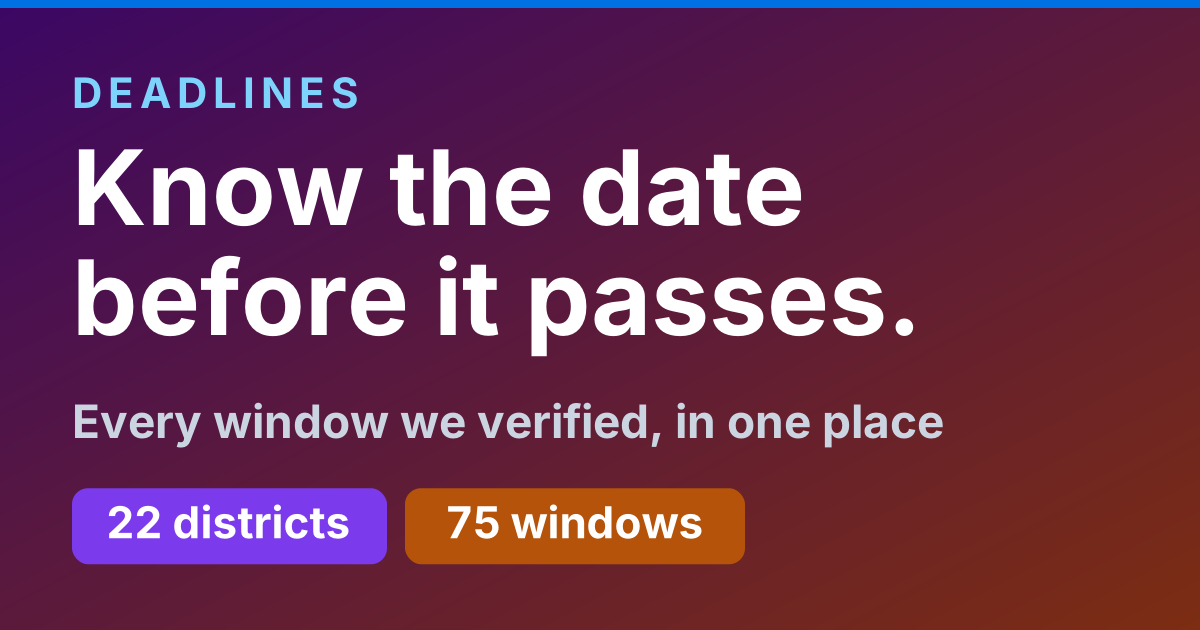
Every Credit by Examination window we have verified from a district's own calendar — 22 districts, 75 windows, each with the source it came from.
See the deadlines →
Not a guess at what might be on it. Full worked solutions and timed mock exams built to the same TEKS the Credit by Examination is written against.
Browse the subjects →5. The plan: diagnose → focus → confirm
Put the three principles together and the strategy writes itself:
- Diagnose (week 1). Take a full-length mock under real timing. Don't worry about the score — you're mapping your weak TEKS categories, not grading yourself.
- Focus (weeks 2–5). Spend your study time on the weakest categories first. Use short, spaced sessions — 30–60 minutes, several times a week — and keep quizzing rather than re-reading.
- Confirm (final 1–2 weeks). Take more timed mocks until you clear the passing bar with a comfortable margin (aim for 10–15 points above the threshold to absorb test-day variance). Treat any low score as information, not panic.
A realistic 6-week timeline
| When | Focus |
|---|---|
| Week 1 | One full-length diagnostic mock. Identify your 2–3 weakest TEKS categories. |
| Weeks 2–3 | Drill the weakest categories. Short spaced sessions, quiz-first. Re-test those categories at the end of week 3. |
| Weeks 4–5 | Mixed full-length practice. Catch the next layer of gaps. Keep weak categories on rotation. |
| Week 6 | Two final timed mocks under real conditions. Light review only in the last few days. Sleep. |
Notice what this plan is not: it is not "study for five weeks, then start practicing." The practicing is the studying. That's the whole point.
How Texas CBE™ is built for this
Our platform is designed around the diagnose-focus-confirm loop:
- Full-length mock exams modeled after the official CBE format — your week-one diagnostic and your week-six confirmation.
- Per-TEKS-category scoring so a mock doesn't just give you a number — it shows you which categories to focus on.
- Unlimited practice with smart question rotation so you can drill a weak category repeatedly without running out of fresh questions.
- Step-by-step explanations on every question — retrieval practice works best when you immediately see why an answer is right or wrong.
- Free sample questions on every subject so you can see the format before you commit.
Full-course access is $29.99 per subject for 3 months — and the earlier in your timeline you start, the more of that diagnose-focus-confirm loop you get to run.
The bottom line: waiting until the exam is close and then cramming is the approach that feels safest and works worst. Diagnosing early and focusing your effort is the approach that feels less urgent and works best. The students who treat practice as the main event — not the final step — are the ones who walk in ready.
This post describes general study strategy based on widely replicated findings in cognitive science. It is not a guarantee of any exam result — outcomes depend on each student's effort, starting point, and the specific exam. Texas CBE™ is an independent practice platform and is not affiliated with, endorsed by, or sponsored by the Texas Education Agency, UT High School, the College Board, or any school district. Always verify current exam requirements with your campus counselor.
→ Browse subjects and start with a free diagnostic question set


