
Texas Pre-Calculus CBE: Cây cầu toán học cuối cùng tới Giải tích đại học


Vì sao Pre-Calculus là CBE đòn bẩy lớn nhất cho học sinh hướng đại học
Với học sinh Texas hướng tới kỹ thuật, khoa học máy tính, vật lý, kinh doanh hay bất kỳ ngành định lượng nào, Pre-Calculus là môn toán quyết định nhất ở bậc trung học. Đó là nền móng mà giải tích giả định — và là nơi đa số sinh viên đại học gặp khó khăn ở Calculus I bị thiếu chuẩn bị.
Lộ trình Credit by Examination (CBE) của Texas cho phép một học sinh tự học bỏ qua cả năm Pre-Calculus tại lớp bằng cách chứng minh khả năng qua một bài thi 3 giờ. Hướng dẫn này tổng hợp mọi thứ ta biết về Pre-Calc CBE: cấu trúc, chủ đề, chiến lược học, và cách biết bạn đã sẵn sàng.
Lưu ý. Texas CBE™ là nền tảng luyện thi độc lập. Chúng tôi không liên kết với UTHS, Đại học Texas tại Austin, Texas Tech University, Texas Education Agency, hay học khu nào. Thông tin ở đây tổng hợp từ chuẩn TEKS công khai và tài liệu UTHS / TTU. Luôn kiểm tra đề hiện hành với cố vấn học đường.
Cấu trúc và định dạng đề
Texas Pre-Calculus CBE chia làm hai kỳ thi học kỳ — Semester A (TEKS §111.42 part 1) và Semester B (part 2). Để nhận tín chỉ Pre-Calculus đầy đủ, bạn phải đậu cả hai.
| Thông số | Pre-Calc Sem A | Pre-Calc Sem B |
|---|---|---|
| Định dạng | Trắc nghiệm, giám sát trực tuyến | Trắc nghiệm, giám sát trực tuyến |
| Thời gian | 3 giờ | 3 giờ |
| Số câu | 50 | 50 |
| Điểm đạt | 70% | 70% |
| Máy tính | Máy đồ thị/khoa học được dùng | Máy đồ thị/khoa học được dùng |
| Bảng công thức | Có sẵn trong đề | Có sẵn trong đề |
Lưu ý: ngưỡng 70% ở trên phản ánh con đường Pre-Calculus UTHS có hướng dẫn trước (bù tín chỉ, TAC §74.24). Pre-Calculus dưới dạng tăng tốc (không có hướng dẫn trước) cần 80% theo TEC §28.023(c). Xác nhận con đường campus sử dụng trước ngày thi.
Đề thi qua hệ thống Proctorio (webcam + lockdown browser). Học sinh thường thi tại nhà trong không gian yên tĩnh, có ID và webcam hoạt động.
Pre-Calculus CBE thực sự kiểm tra gì
Đề bám Texas TEKS §111.42, chuẩn Pre-Calculus của bang. Các chủ đề chia theo hai học kỳ như sau:
Học kỳ A — Hàm số và chủ đề phi lượng giác
- Mathematical Process Standards (1A–1G) — vận dụng toán vào tình huống thực, biểu diễn đa dạng, giao tiếp chính xác với đơn vị, biện luận lời giải.
- Hàm số và tính chất (2A–2J) — miền, tập giá trị, hành vi đầu mút, hợp hàm, hàm ngược, hàm từng phần, biến đổi (tịnh tiến, co giãn, đối xứng).
- Hàm đa thức và hữu tỷ (3A–3D) — tìm nghiệm, phân tích nhân tử, tiệm cận (đứng, ngang, xiên), điểm khuyết, bội nghiệm, hành vi đầu mút, bất phương trình hữu tỷ.
- Hàm mũ và logarit (3E–3I) — tính chất số mũ và log, đổi cơ số, giải phương trình mũ/log, mô hình tăng trưởng/suy giảm, lãi kép, chu kỳ bán rã.
Học kỳ B — Lượng giác và chủ đề nâng cao
- Hàm lượng giác (4A–4G) — đo radian và độ, đường tròn đơn vị, sin/cos/tan/csc/sec/cot, các góc đặc biệt (π/6, π/4, π/3), đồ thị và biến đổi hàm sin, độ dài cung, vận tốc góc, hàm lượng giác ngược.
- Đồng nhất thức và phương trình lượng giác (4H–4K) — đồng nhất thức Pythagoras, công thức cộng/trừ, công thức nhân đôi, công thức nửa góc, giải phương trình lượng giác.
- Dãy và chuỗi (5A–5C) — cấp số cộng và cấp số nhân, ký hiệu sigma, tổng riêng, hội tụ chuỗi hình học vô hạn.
- Conic, tham số, cực, vector (5D–5I) — đường tròn, elip, parabol, hyperbol; tâm sai; phương trình tham số; tọa độ và đường cong cực; vector (độ lớn, cộng, tích vô hướng, hình chiếu).
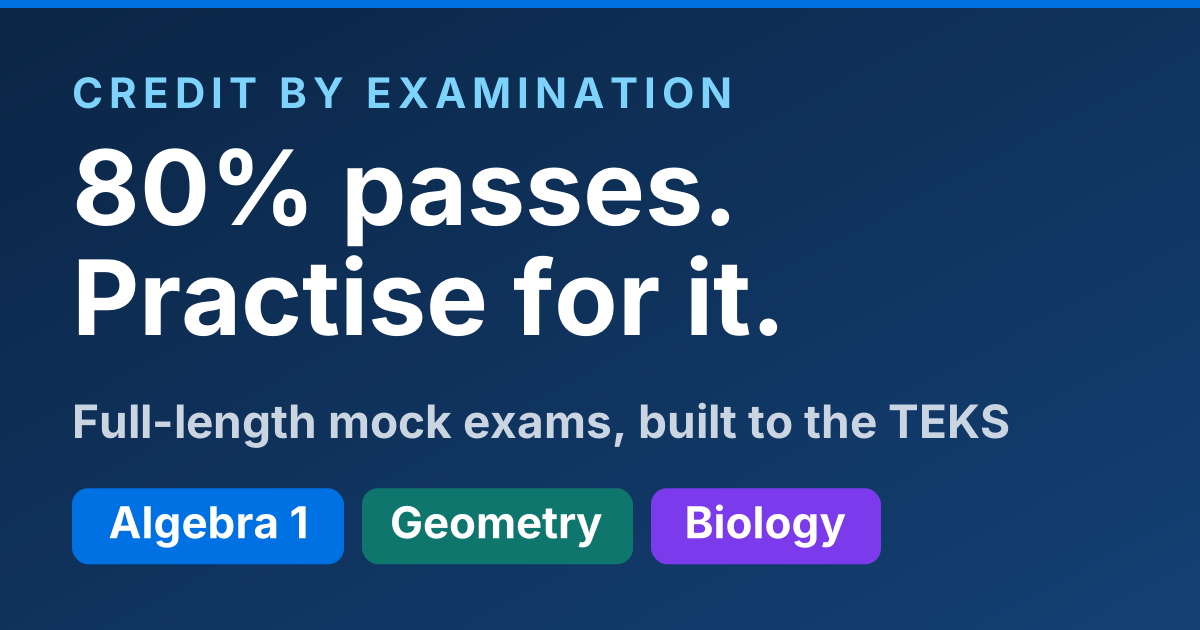
Credit by Examination asks for 80% with no prior instruction. Full-length mock exams written to the same TEKS the exam is drawn from — Algebra 1, Geometry, Biology, Chemistry and more.
See the subjects →
Every subject has free practice questions with the full worked solution. Take some and see whether they look like the exam your district set.
See the subjects →
Every Credit by Examination window we have verified from a district's own calendar — 22 districts, 75 windows, each with the source it came from.
See the deadlines →
Not a guess at what might be on it. Full worked solutions and timed mock exams built to the same TEKS the Credit by Examination is written against.
Browse the subjects →Hai cụm chủ đề khó nhất
Theo phản hồi từ tài liệu UTHS và TTU, hai dạng câu hỏi gây rớt Pre-Calc CBE nhiều nhất:
- Phương trình lượng giác có nhiều nghiệm — học sinh quên rằng sin(x) = ½ có HAI nghiệm trong [0, 2π], hoặc xử lý sai chu kỳ khi giải sin(2x) = …. Luyện đến mức tự động kiểm tra cả hai góc phần tư tham chiếu.
- Phương trình logarit có ràng buộc miền — học sinh giải ln(x) + ln(x − 3) = ln(10) đại số rồi quên loại nghiệm ngoại lai khi tham số gốc của log ≤ 0. Luôn kiểm tra miền ở bước cuối.
Kế hoạch ôn 4 tuần
Nếu nền Algebra 2 vững và có 4 tuần để ôn, đây là lịch khả thi:
| Tuần | Trọng tâm | Thời gian/ngày |
|---|---|---|
| Tuần 1 | Hàm số, đa thức, hàm hữu tỷ (nền Sem A) | 45–60 phút |
| Tuần 2 | Hàm mũ, logarit (hoàn tất Sem A) + bắt đầu đường tròn đơn vị (Sem B) | 60 phút |
| Tuần 3 | Lượng giác, đồng nhất thức, phương trình (cốt lõi Sem B) | 60–90 phút |
| Tuần 4 | Dãy, conic, cực, vector + 3 đề mô phỏng đầy đủ | 60 phút + mô phỏng |
Nếu Algebra 2 đã rỉ, thêm 1 tuần ôn nền trước kế hoạch. Cố học Pre-Calc khi chưa thành thạo Algebra 2 là lý do phổ biến nhất khiến rớt.
Ai nên thi Pre-Calc CBE (và ai không nên)
Ứng viên phù hợp:
- Học sinh giỏi Algebra 2 đã tự học Pre-Calc trong hè.
- Học sinh đã học khóa tương tự (ví dụ AP Pre-Calculus prep, college algebra) và muốn Pre-Calc trên học bạ.
- Học sinh học vượt cấp dự định học Calculus học kỳ sau và cần tín chỉ Pre-Calc.
Chờ thi nếu:
- Chưa từng học lượng giác (đường tròn đơn vị, đồng nhất thức) — không thể nhồi nhét trong một tuần.
- Điểm mô phỏng Algebra 2 dưới 70%.
- Chưa luyện đủ bài tập của cả hai học kỳ và đạt ổn định trên 80%.
Thử bài luyện Pre-Calc miễn phí
Ngân hàng Pre-Calculus của chúng tôi có 300 câu mỗi học kỳ (tổng 600), mỗi câu gắn với phân loại TEKS cụ thể, kèm giải thích từng bước. Bản miễn phí cho bạn 10 câu mẫu mỗi học kỳ để thấy chính xác đề thi kiểm tra gì.
Nguồn tham khảo: Texas Administrative Code 19 TAC §111.42 · Chương trình Credit by Exam của UT High School · Credit by Exams của Texas Tech K-12. Luôn xác nhận ngày và chính sách cụ thể với cố vấn học đường.
Câu hỏi Thường gặp
Should my child take Pre-Calculus by CBE?
How long does Pre-Calculus CBE prep take?
What's on the Pre-Calculus CBE?
Is Pre-Calculus CBE harder than Algebra 2?
Can I skip Pre-Calculus entirely and go to AP Calculus?
- UT High School (UTHS) — Primary CBE provider for Texas districts
- 19 TAC §74.24 — CBE for prior instruction, 70% threshold
- Texas Education Agency (TEA) — State agency — TEKS, STAAR, and graduation rules
- TEKS §111.42 (Pre-Calculus)


