Ciclos biogeoquímicos: carbono, agua y nitrógeno
Los átomos circulan por los ecosistemas sin fin. Domina el ciclo del carbono (fotosíntesis ↔ respiración), el ciclo del agua (evaporación/precipitación) y el ciclo del nitrógeno (fijación + desnitrificación).


Los átomos se reciclan; la energía no
Uno de los principios más profundos de la ecología: la energía fluye en una sola dirección (sol → productor → consumidor → calor), pero la materia cicla. El mismo átomo de carbono en tu cuerpo pudo haber estado en un dinosaurio, en un helecho o en la atmósfera hace mil millones de años.
El CBE se centra en tres ciclos. Cada uno tiene la misma estructura: reservorios (dónde se acumula el elemento) y procesos (cómo se mueve entre ellos).
El ciclo del carbono
El carbono es el esqueleto de toda molécula orgánica. Se mueve entre cuatro reservorios principales:
- Atmósfera — como CO₂.
- Plantas y animales — en glucosa, proteínas, grasas, DNA.
- Suelo y descomponedores — en materia muerta en proceso de descomposición.
- Combustibles fósiles y océano — almacenamiento a largo plazo.
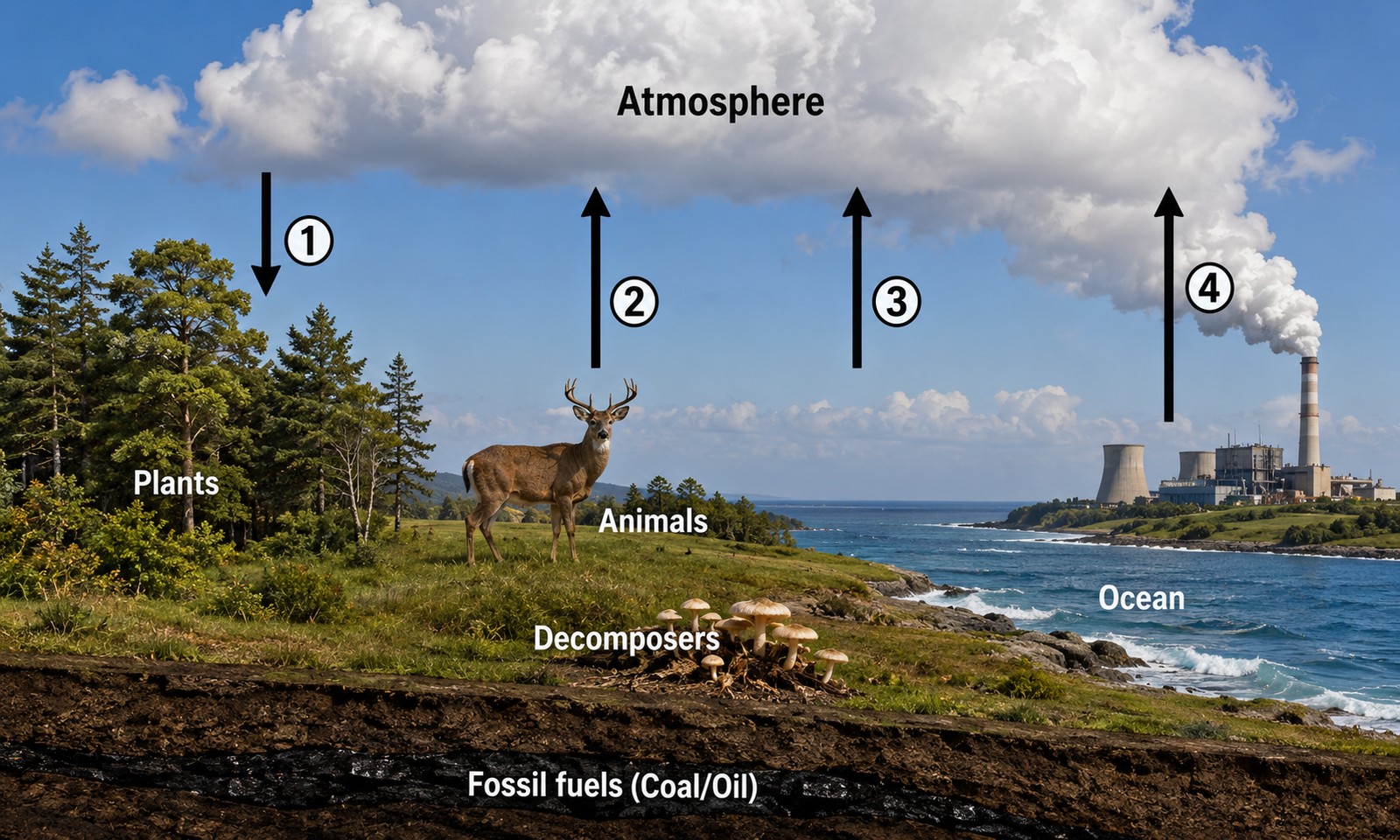
- Fotosíntesis — extrae CO₂ de la atmósfera hacia el tejido vegetal. (Atmósfera → plantas)
- Respiración celular — libera CO₂ desde animales/plantas de vuelta a la atmósfera. (Organismos → atmósfera)
- Descomposición — los descomponedores rompen la materia muerta, liberando CO₂. (Descomponedores → atmósfera)
- Combustión — quemar combustibles fósiles o madera libera CO₂. (Combustible → atmósfera)
El ciclo del agua
El ciclo del agua tiene cuatro procesos principales que debes conocer:
- Evaporación — el agua líquida se convierte en vapor (sobre todo desde océanos y lagos).
- Transpiración — vapor de agua liberado por las hojas de las plantas a través de los estomas.
- Condensación — el vapor se enfría y forma nubes.
- Precipitación — la lluvia, la nieve o el granizo caen de vuelta a la superficie.
El circuito completo: océano → evaporación → nubes → precipitación → ríos → océano.
El ciclo del nitrógeno
La atmósfera es 78% nitrógeno gaseoso (N₂), pero plantas y animales no pueden usarlo directamente. Las bacterias hacen todo el trabajo pesado.
- Fijación del nitrógeno — las bacterias convierten el N₂ atmosférico en amoníaco (NH₃) o nitrato (NO₃−) utilizables. La mayoría de las bacterias fijadoras vive en los nódulos radiculares de las leguminosas (chícharos, frijoles, trébol).
- Nitrificación — bacterias del suelo convierten amoníaco → nitritos → nitratos.
- Asimilación — las plantas absorben los nitratos del suelo y los usan para construir proteínas y DNA.
- Descomposición (amonificación) — los descomponedores rompen la materia orgánica muerta convirtiéndola nuevamente en amoníaco.
- Desnitrificación — bacterias del suelo convierten los nitratos otra vez en N₂ atmosférico. Cierra el ciclo.
Extra: mutualismo en el ciclo del nitrógeno
Las leguminosas (chícharos, frijoles, trébol) hospedan bacterias fijadoras de nitrógeno en nódulos radiculares especiales. Las bacterias obtienen azúcares de la planta; la planta obtiene nitrógeno utilizable. Un caso clásico de mutualismo.