DNA Structure & Replication: The Code of Life and How It Copies Itself
Three things every CBE asks: the four bases (A, T, G, C) and how they pair, the double helix structure, and semi-conservative replication. Plus the four enzymes that make replication work.


DNA in three pieces
The CBE tests DNA in three predictable pieces:
- Structure — the double helix, sugar-phosphate backbone, and base pairs.
- Pairing rules — A always with T, G always with C.
- Replication — how the double helix copies itself before cell division.
Structure: the double helix
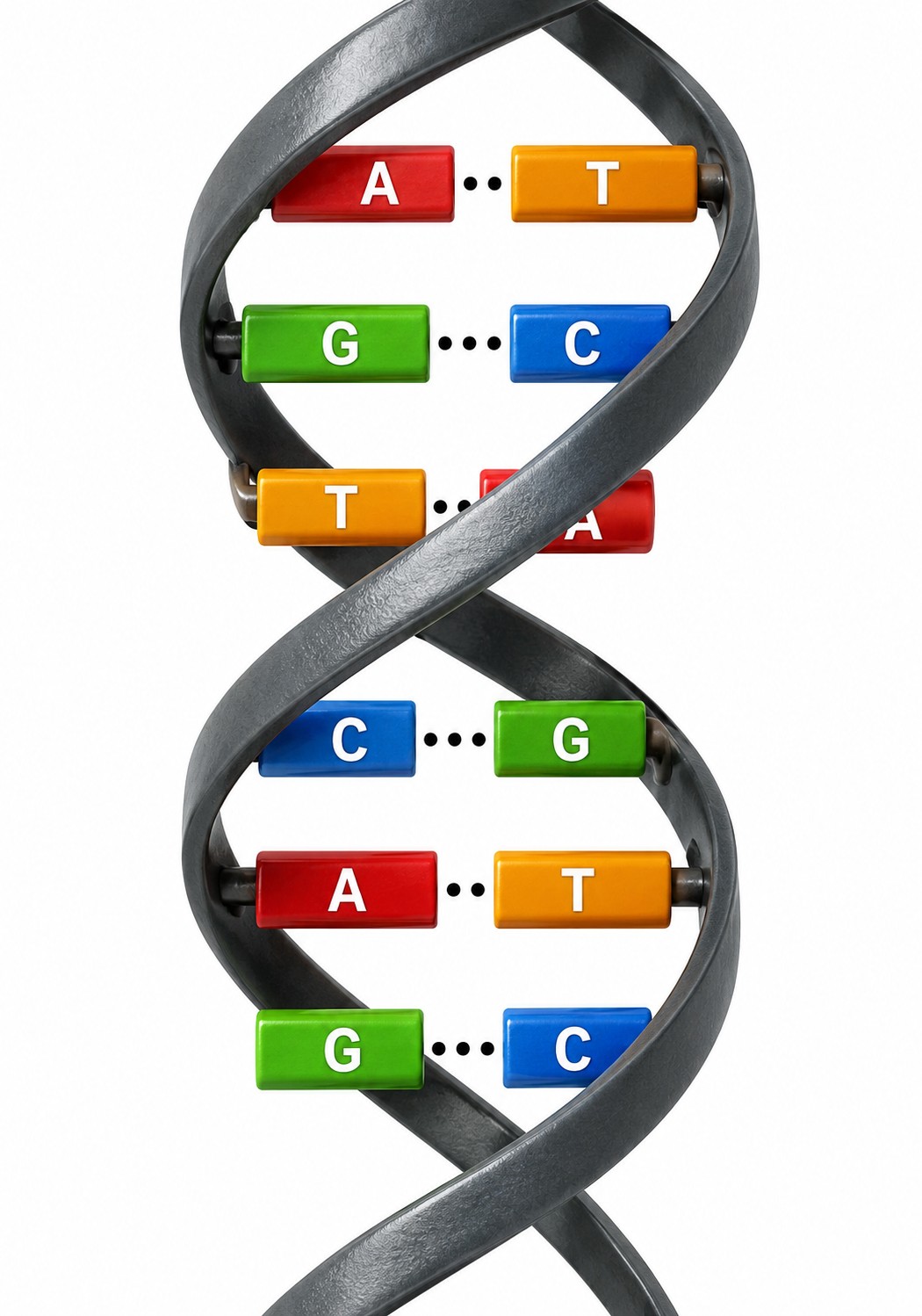
DNA looks like a twisted ladder:
- The sides of the ladder are made of sugar (deoxyribose) and phosphate, alternating.
- The rungs are pairs of nitrogen bases connected by hydrogen bonds.
- The whole ladder is twisted into a helix (hence “double helix”).
The four bases — and the only two pairings
There are exactly four bases in DNA:
- A denine — pairs only with T
- T hymine — pairs only with A
- G uanine — pairs only with C
- C ytosine — pairs only with G
The base-pair rule
A pairs with T. G pairs with C. Always. Memorize “Apples in Trees, Cars in Garages.”If one strand reads 5'-ATCG-3', the complementary strand must read 3'-TAGC-5' — every A becomes T, every G becomes C, and vice versa.
RNA: the cousin with one swap
RNA is similar to DNA with three differences:
- RNA is single-stranded; DNA is double-stranded.
- RNA uses ribose; DNA uses deoxyribose.
- RNA replaces thymine (T) with uracil (U). So in RNA, A pairs with U.
Replication: semi-conservative
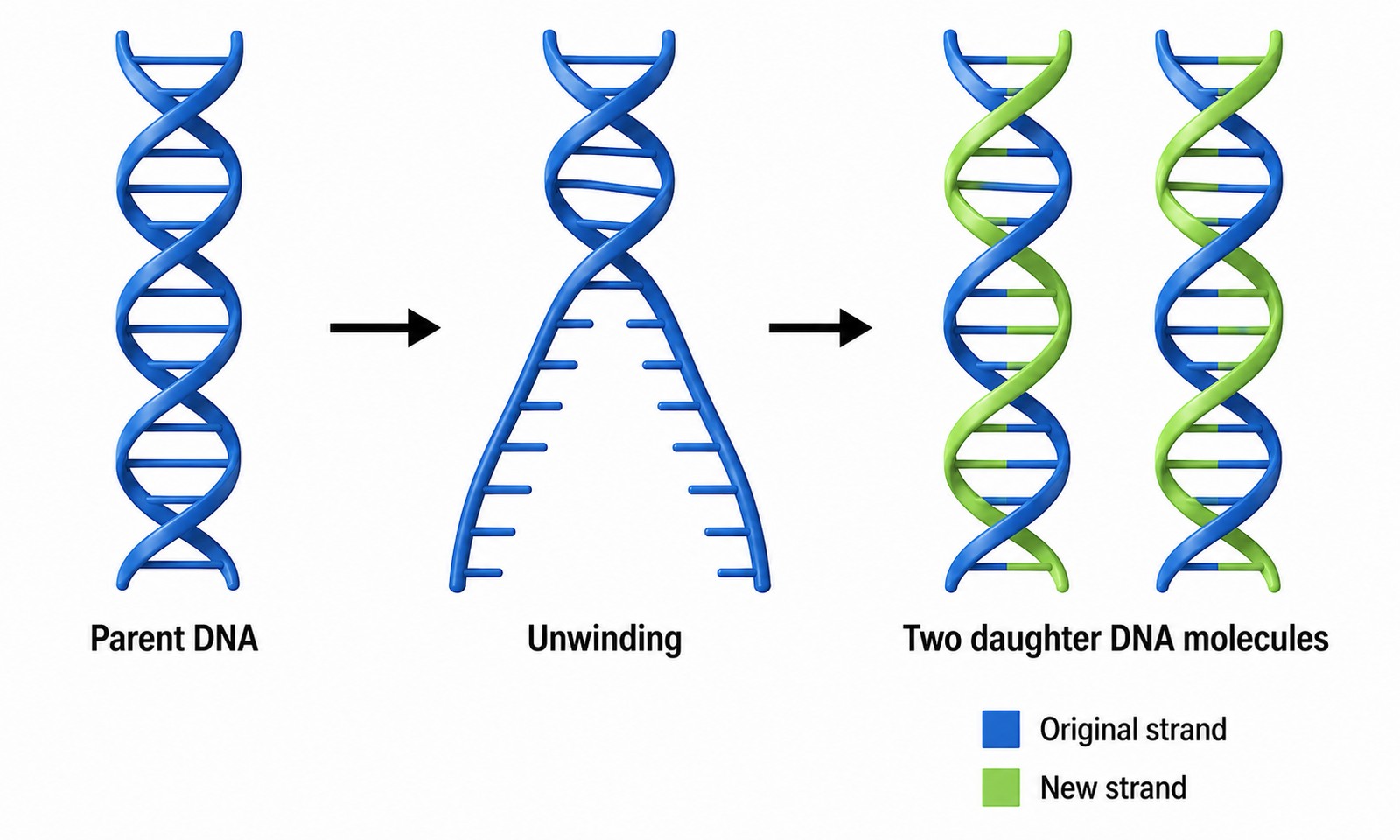
Before any cell can divide, it must copy its DNA. The copying mechanism is called semi-conservative replication — meaning each new double helix contains one old strand and one newly made strand. Half is preserved, half is new.
The four enzymes you must know
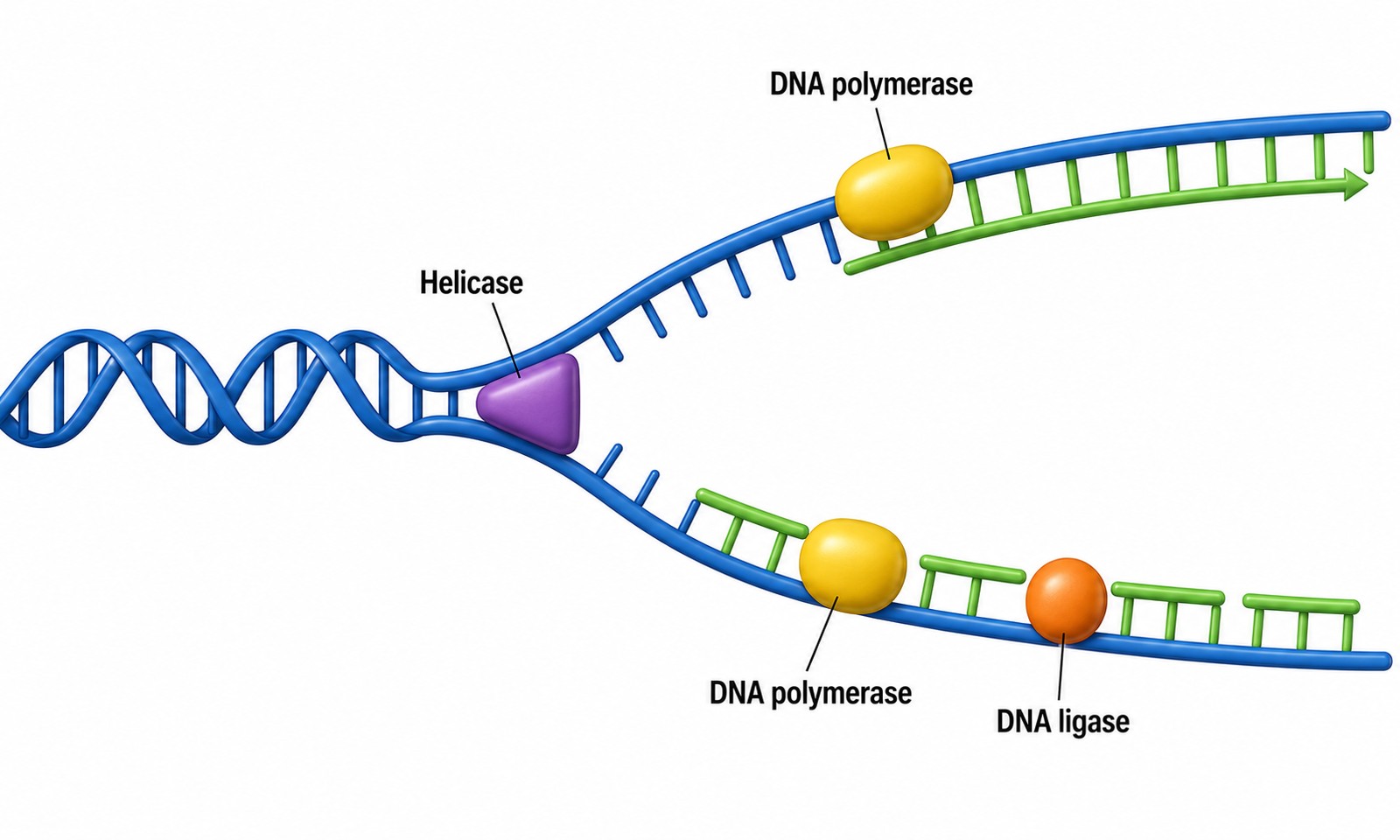
Replication needs a coordinated team:
- Helicase — unwinds and separates the two parent strands at the replication fork.
- DNA polymerase — adds new nucleotides to build the new strand, reading the template 3'→5' and synthesizing 5'→3'.
- DNA ligase — joins the small Okazaki fragments on the lagging strand.
- Primase — lays down a short RNA primer that polymerase needs to start.
Check yourself
Quick check #1
If one DNA strand reads 5'-ATCG-3', what is the complementary strand?
A pairs with T, G pairs with C — applied base by base: A→T, T→A, C→G, G→C. So 5'-ATCG-3' pairs with 3'-TAGC-5'.
Quick check #2
Each daughter DNA molecule contains one strand from the parent and one newly synthesized strand. What is this called?
“Semi” means half. Half of each new helix (one strand) is preserved from the parent — confirmed by Meselson and Stahl's classic 1958 experiment.