Cell Structure & Organelles: A Tour Inside the Cell
Every Texas Biology CBE has at least one organelle-identification question. Master the eight structures every cell biology question is built around — what each one looks like, what it does, and how plant cells differ from animal cells.


Why organelles dominate this exam
Roughly 15% of the Texas Biology CBE tests organelle identification — either by name (“Which organelle produces ATP?”) or by picture (“The organelle labeled X is the…”). The good news: you only need to know eight structures, and most have one signature feature you can spot in any diagram.
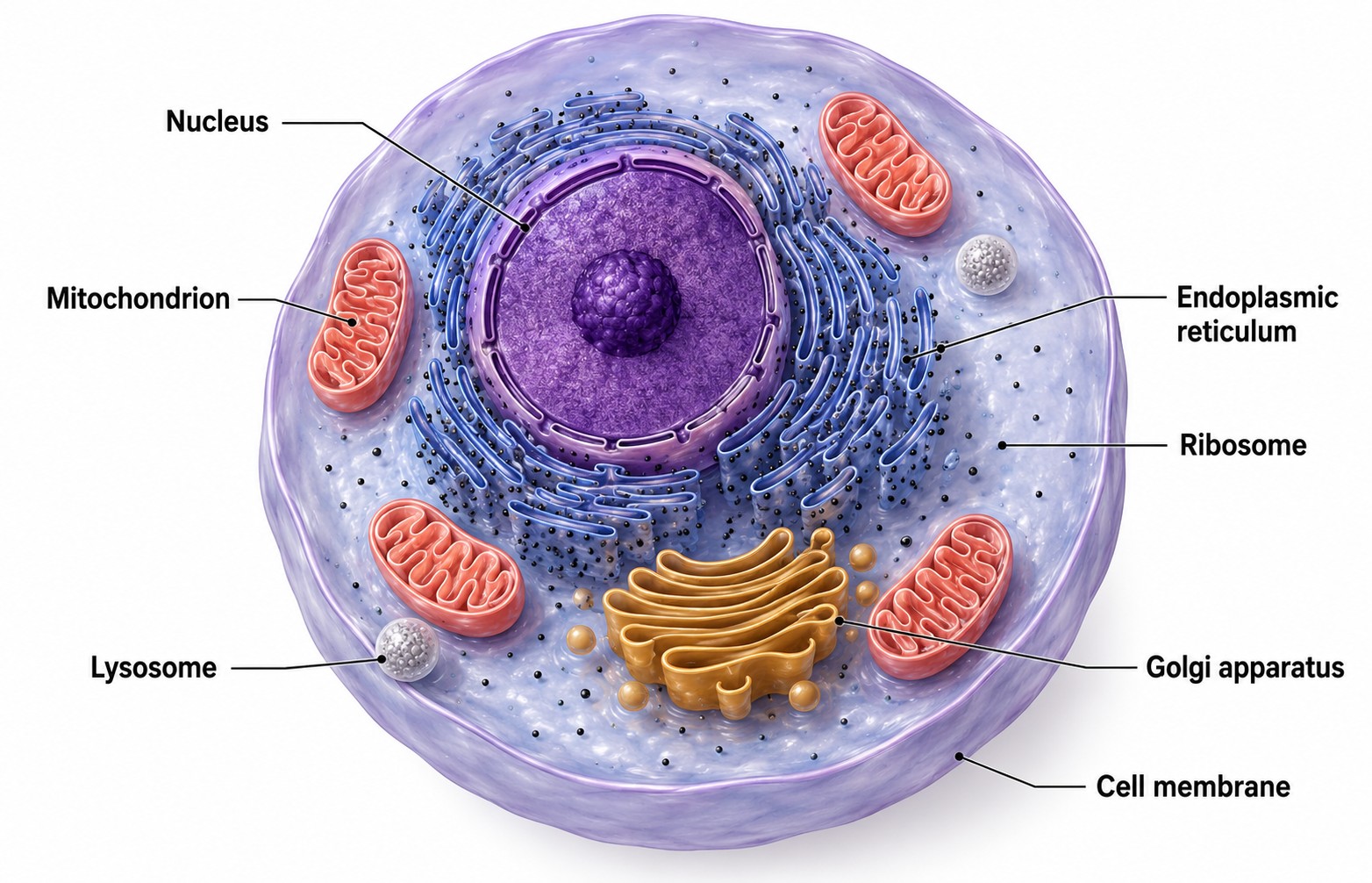
- Nucleus — large round structure, dark center (nucleolus). Stores DNA.
- Mitochondrion — bean-shaped with inner folds (cristae). Makes ATP.
- Endoplasmic reticulum (ER) — winding membrane network. Rough ER has ribosomes.
- Golgi apparatus — stack of flat curved sacs. Packages proteins.
- Ribosomes — tiny dots on ER or floating free. Synthesize proteins.
- Lysosomes — small round vesicles. Break down waste.
- Cell membrane — outer thin boundary of every cell. Controls entry/exit.
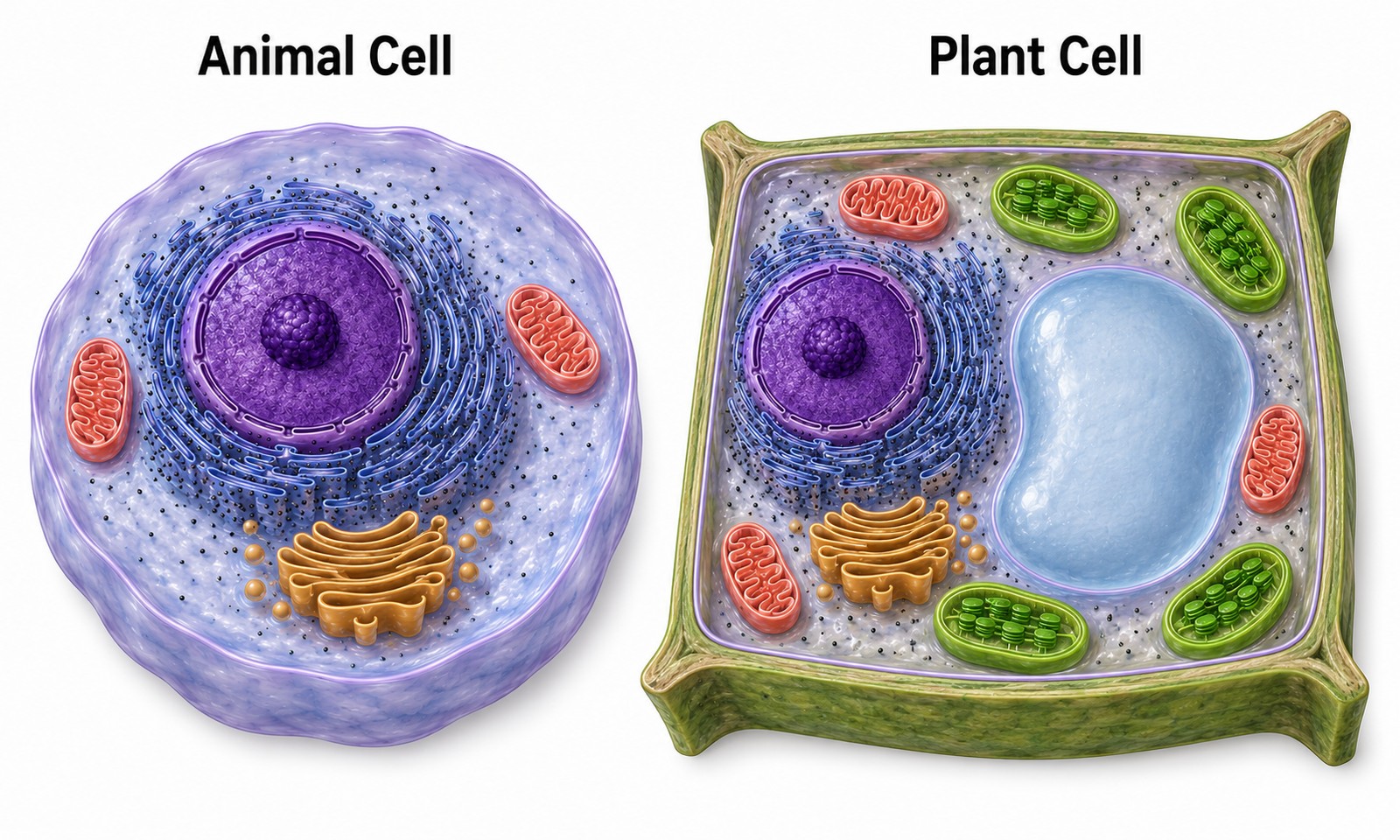
- Cell wall + chloroplast + vacuole — plant cells only. Wall = rigid outer; chloroplasts = green ovals; vacuole = giant central bubble.
The standard animal-cell diagram
Almost every cell-identification question on the CBE uses the same textbook illustration style. Here’s the canonical layout you should be able to recognize:
Visual signatures — how to spot each one
On the exam you’ll see a single diagram and four answer choices. Don’t memorize positions; memorize what each organelle uniquely looks like:
Plant cells: three structures animal cells lack
If the diagram is rectangular with a thick green-brown outer border, it’s a plant cell. Three structures are only in plant cells:
- Cell wall — the rigid green-brown outer layer (outside the membrane).
- Chloroplasts — green ovals with stacked discs (thylakoids) inside. Site of photosynthesis.
- Central vacuole — one giant pale-blue bubble taking up 30–50% of the cell. Stores water/keeps the cell turgid.
Three-step strategy for any cell-ID question
- Identify the cell type first — square with green wall = plant; round irregular = animal.
- Match the visual signature to the function asked — “makes ATP” → bean shape with folds; “packages proteins” → stacked sacs; “stores DNA” → biggest dark structure.
- Eliminate distractors — if the question asks for a plant-only structure (e.g., “chloroplast”), distractors will include animal-only structures.
Check yourself
Apply it to CBE-style practice questions
Every concept above is commonly tested on the CBE. Try these questions to lock it in: